The Question Behind the Question
When a parent asks us about martial arts vs team sports, they're rarely asking in the abstract. Usually something specific has happened.
Their kid sat on the bench all season. Their kid got cut. Their kid is technically on the team but hasn't touched the ball in four games. Their kid is fast and coordinated but falls apart when the team loses. Or their kid simply doesn't want to go anymore, and won't say why.
So let's skip the sales pitch. Team sports are genuinely excellent for a lot of children, and if your kid is thriving in soccer, we'd tell you to keep them in soccer. This is an honest comparison of what each format actually does — and, more usefully, which kinds of kids do better in which.
What Team Sports Do Well
Credit where it's due. Team sports deliver things martial arts genuinely cannot:
Shared purpose. Learning to subordinate what you want to what the group needs is a real developmental skill, and nothing teaches it like a team that wins and loses together.
Built-in social structure. A season creates a ready-made friend group with shared history. For socially confident kids, this is enormous.
Reading a live field. Sports like soccer, basketball, and hockey develop spatial awareness and split-second decision-making across a chaotic, moving environment. That's a distinct cognitive skill.
Community. Saturday games, team dinners, other parents on the sideline. It's a social fabric for the whole family, not just the child.
If your kid gets meaningful playing time and comes home happy, none of what follows should tempt you away.
Where Team Sports Struggle
The problems tend to be structural rather than anyone's fault.
Playing time is finite and competitive. There's one ball and a bench. As kids get older, coaches — even kind ones — play the kids who help them win. A child who develops slowly can spend two seasons watching, and no amount of encouragement makes watching into practice.
Progress is invisible. A kid can get substantially better at basketball over a season and have nothing to point at. Team wins are shared and diffuse; individual improvement goes unmarked. For a child who needs to see that they're getting better, this is quietly demoralizing.
Coach-to-kid ratios are brutal. One coach, sometimes two, for fifteen or twenty children. Individual correction is rare by necessity. The kids who already have it get better; the kids who need help get "good effort!"
Seasons end. Three or four months on, then a gap. Whatever momentum a child built dissipates, and next season everyone restarts — often with a new coach, new teammates, and new social politics.
The cut is coming. Somewhere between ages ten and thirteen, most competitive team sports start selecting. For kids on the wrong side of that line, the message is unambiguous: you are not good enough to continue. That's a hard thing to hand an eleven-year-old.
Where Martial Arts Is Structurally Different
Martial arts isn't better because it's more virtuous. It's different because the structure is different in five specific ways.
1. Nobody sits on the bench
Every child participates for the entire class, every class. There's no bench, no rotation, no lineup. A shy, slow-developing eight-year-old gets exactly as many repetitions as the natural athlete standing next to them.
For a kid who's spent a season watching, this alone can change their relationship with sport.
2. Progress is individual, visible, and constant
This is the big one, and it's why martial arts often works for kids who've bounced off everything else.
Your child competes against last week's version of themselves. Belts, stripes, and new techniques mark that progress in a way a child can see, hold, and explain to their grandparents. The feedback loop is short: I couldn't do this in September. I can do it now.
Team sports rarely produce that. A season of soccer ends with a trophy everyone got or a record nobody controlled.
3. Losing happens in private, constantly, and safely
Here's an underappreciated point. In a grappling class, your kid loses — a lot. Every single class. To bigger kids, smaller kids, and kids who've been there longer.
But it happens in a controlled room with a coach three feet away, not in front of a crowd, and it resets in ninety seconds. Kids build a tolerance for failure at a manageable dose, over and over. That's a fundamentally different experience from missing the shot that lost the game, which is one loud failure with a large audience.
Parents consistently tell us this is the change they notice first: their kid stops falling apart when things go wrong.
4. The ratio is better and the correction is personal
Martial arts classes are typically smaller, and the format is built around a coach circulating and adjusting individual kids. Your child gets told their specific name and their specific fix, several times per class. Over a year, that's hundreds of individual corrections versus a handful.
5. It never ends
No seasons, no off-season, no tryouts, no cut. A child can train continuously from age five to eighteen with steady progression the whole way. That continuity is a stabilizing force — especially for kids who struggle with transitions and change.
Where Martial Arts Falls Short
An honest comparison has to go both directions.
Less teamwork by design. Martial arts builds partnership and mutual respect, but it does not replicate the experience of eleven people executing a shared plan. If your goal is specifically to teach your child to function as part of a unit, a team sport does it more directly.
Less aerobic in some formats. A soccer game involves running for an hour. Some martial arts classes are more technique-focused than cardio-focused. If a child needs to burn a great deal of physical energy, ask about class structure before assuming.
Quality varies wildly. Youth sports leagues are variable, but martial arts is worse — the industry has no licensing, and there are schools that sell belts on payment plans and run classes that are essentially expensive daycare. This is a real risk and you have to screen for it. We wrote a full guide on how to choose a martial arts gym, and the ten-minute trial-class test in it applies directly to kids' programs.
Less spectator-friendly. You'll watch practice, not games. Some parents love this; some miss the Saturday morning ritual.
Four Kid Profiles Where Martial Arts Usually Wins
Rather than generalize, here's where we've consistently seen the difference:
The kid who's smaller or developing later. In team sports, physical maturity dominates until roughly fifteen. In martial arts, a smaller kid learns leverage and technique that genuinely neutralize size — and discovers they can handle bigger kids, which does something permanent to how they carry themselves.
The kid who freezes under crowd pressure. Some children have real ability that evaporates when people are watching. Martial arts removes the audience, then reintroduces pressure gradually and privately.
The kid who needs constant structure and immediate feedback. Children with ADHD, attention difficulties, or anxiety often struggle in the loose, unpredictable environment of a field sport but thrive in a class with clear rules, a predictable format, and instant correction. We went deep on why in martial arts for kids with ADHD and anxiety.
The kid who's been cut, benched, or quietly excluded. For a child whose confidence has taken a hit, an environment where participation is guaranteed and progress is personal can rebuild something the team environment took away.
The Practical Stuff Parents Actually Ask About
Cost. Broadly comparable. Team sports look cheaper on the registration fee, then add equipment, uniforms, tournament travel, and club fees. Martial arts is a steadier monthly cost with a uniform and occasional gear. Watch for schools that push mandatory testing fees, mandatory equipment packages, or long-term contracts — those are the ones where the real cost hides.
Time. Team sports front-load: multiple practices plus weekend games in season. Martial arts is usually two to three sessions a week, year-round, with no weekend obligation unless a child chooses to compete.
Injury. Both carry risk. Contact team sports have meaningful concussion exposure. Youth martial arts — particularly grappling, where there's no striking to the head — tends toward sprains, bruises, and mat burn. Properly supervised kids' Jiu-Jitsu and wrestling are among the safer options in youth sport.
Do they have to choose? No, and most families we work with don't. Martial arts two evenings a week alongside a seasonal sport is extremely common — and the two complement each other well. Balance, body awareness, and composure under pressure transfer directly onto the field.
What This Looks Like Here
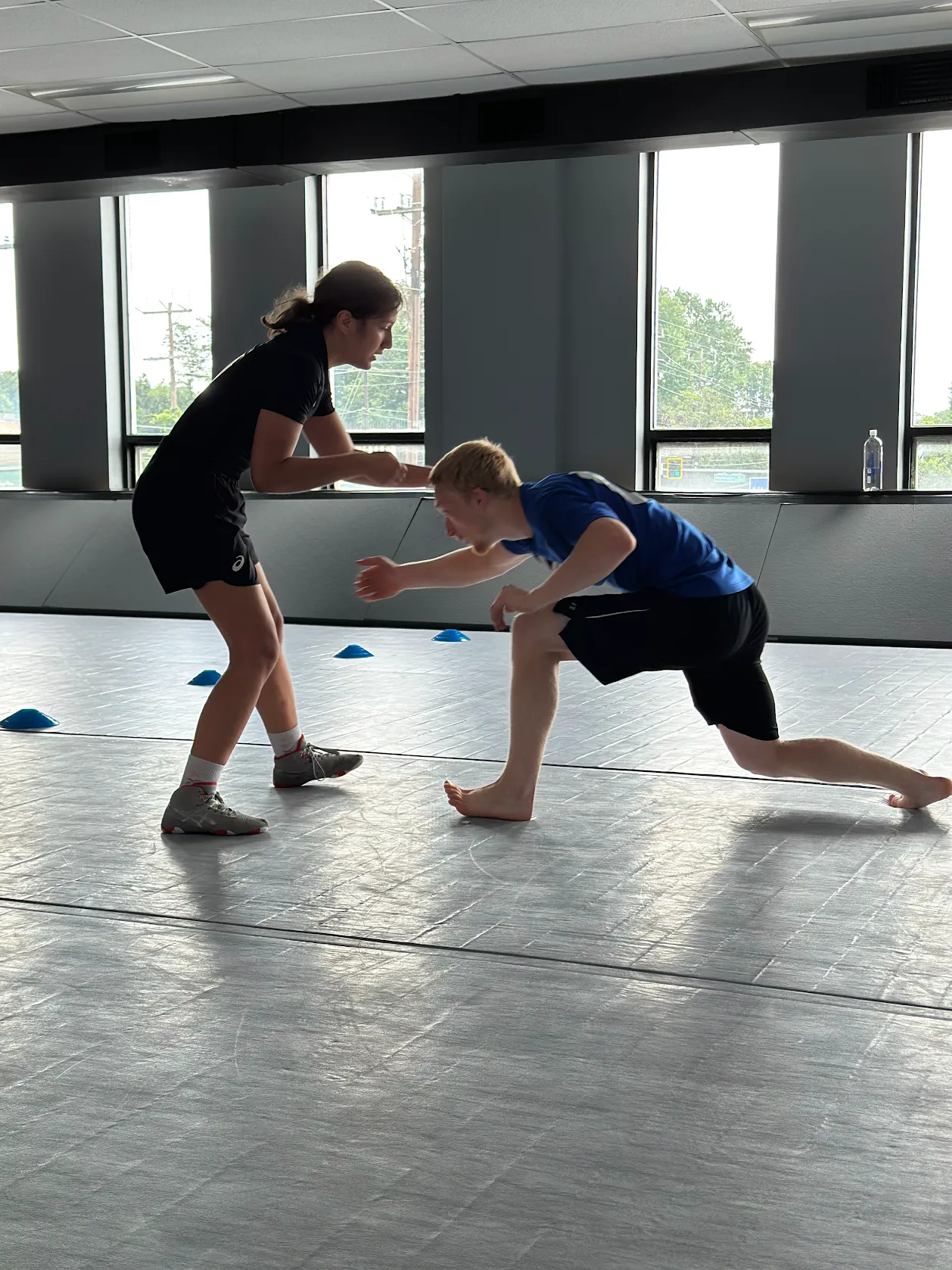
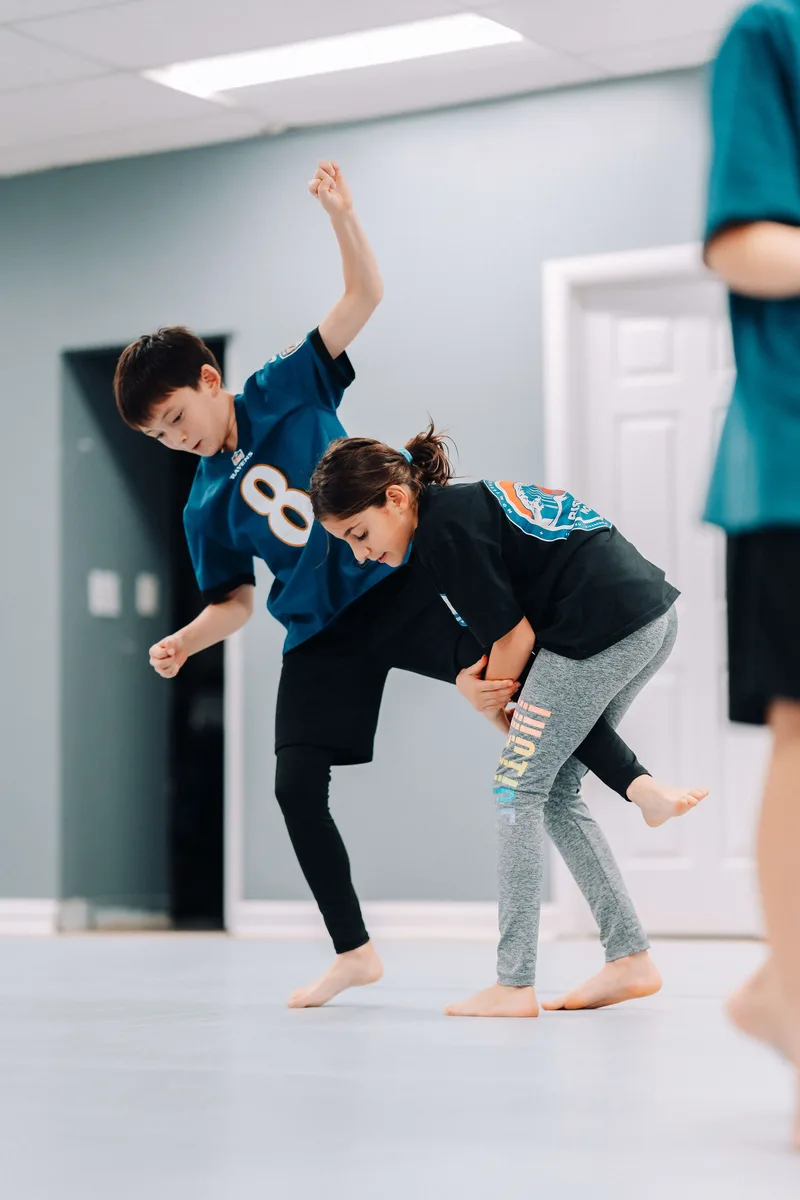
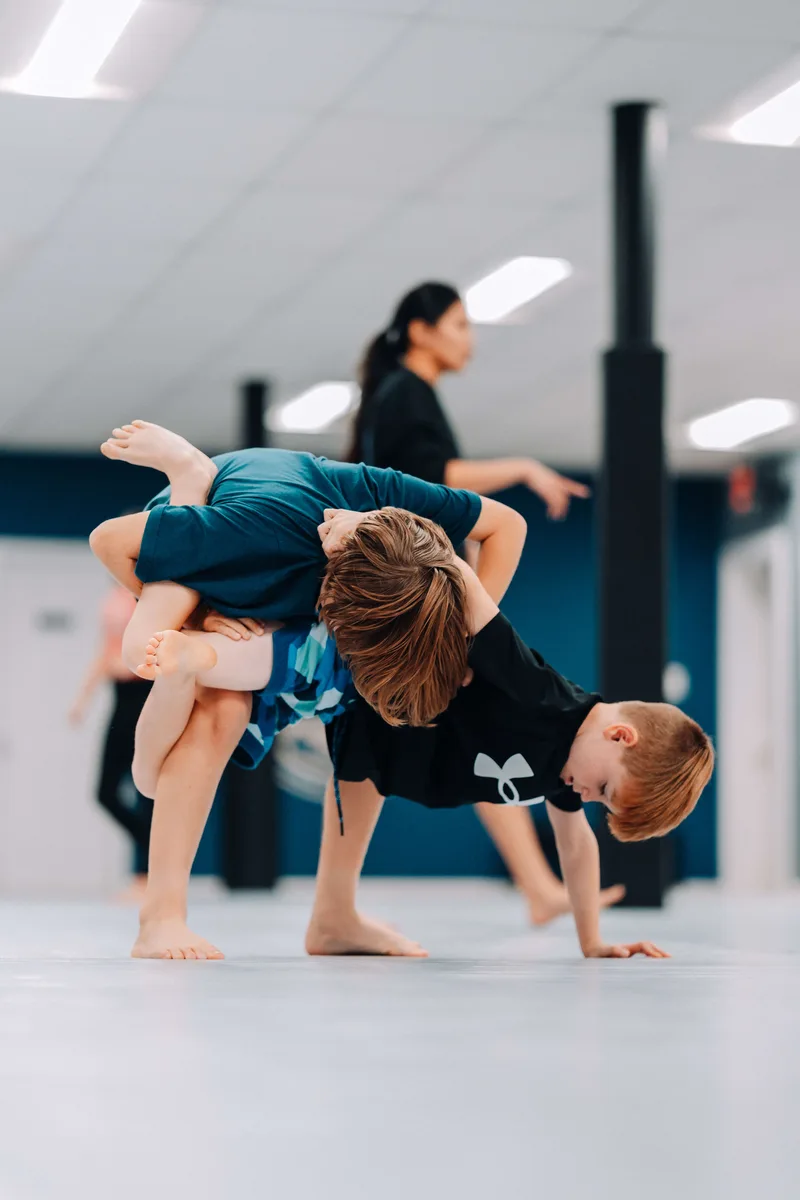
Our kids martial arts program runs Monday through Saturday for ages 5–15, with Kids Gi Jiu-Jitsu Monday, Tuesday, and Thursday at 5:30 PM, Kids Wrestling Wednesday at 5:30, Kids Kickboxing Wednesday and Friday at 6:30, and Kids No-Gi on Friday evening and Saturday at 11:00 AM.
That spread is deliberate: families with an in-season sport can train twice a week around it, and families going all-in have six options. Kids are grouped by age and experience, every child participates the whole class, and coaches correct kids by name.
If you're not sure your child is old enough, what age should kids start martial arts breaks it down by developmental stage rather than by birthday.
We're at 5408 Randolph Road in Rockville, second floor, free parking. Families drive in from across the county — see kids martial arts near Rockville, kids martial arts near Bethesda, or the Potomac martial arts page for directions and drive times.
The first class is free, and we'd genuinely rather your child try one and decide it's not for them than sign up for something they'll resent.
The Bottom Line
If your child is getting real playing time in a team sport, loves going, and comes home happy — stay. That's working.
If your child is on the bench, has been cut, freezes when watched, needs more individual attention than a 20-to-1 field can provide, or has simply stopped wanting to go, martial arts solves those specific problems structurally. Not because it builds better character, but because there's no bench, progress is visible, failure is small and frequent, and the season never ends.
Most kids don't have to pick. But if yours has been quietly struggling in a format that can't give them what they need, it's worth one free class to find out.
Frequently Asked Questions
Is martial arts better than team sports for kids?
Neither is universally better. Team sports excel at shared purpose, social structure, and live decision-making. Martial arts excels at guaranteed participation, individual progress, and continuous year-round development. The right answer depends on your specific child — particularly whether they're getting real playing time and coming home happy.
Can my child do martial arts and a team sport at the same time?
Yes, and it's common. Most martial arts programs run two to three sessions a week with no weekend games, so they fit around a seasonal sport. The skills transfer well — balance, body awareness, and composure under pressure all show up on the field.
Is martial arts safer than football or soccer for kids?
Grappling-based martial arts like Jiu-Jitsu and wrestling generally carry lower head-injury risk than contact team sports, since there's no striking to the head. Expect sprains, bruises, and mat burn instead. Supervision quality matters more than the sport — ask any program directly about their safety rules and age grouping.
At what age should a kid switch from team sports to martial arts?
There's no switching age, and framing it as a switch is usually a mistake. The common trigger points are when a child gets benched or cut (often ages 10–13), or when they lose interest and can't say why. Trying a free martial arts class while still in their sport gives you real information without forcing a choice.
Will martial arts make my child aggressive?
Consistently the opposite, in our experience and in the research. Kids who train regularly have less to prove — they know what real physical conflict feels like and have no interest in it. Good programs also make de-escalation and self-control explicit parts of the curriculum, not an afterthought.