The Short Answer
Martial arts builds confidence in kids by giving them a steady supply of earned evidence that they can do hard things. A child who couldn't escape a pin in September and can do it in November doesn't need to be told they're capable. They have proof.
Psychologists have a name for that kind of confidence — self-efficacy — and decades of research on where it comes from line up remarkably well with how a good martial arts class is structured. The studies on martial arts specifically are promising too, with one honest caveat that every parent should know before signing up anywhere.
Here's the science, in plain language.
What "Confidence" Actually Means
When parents say they want their child to be more confident, they usually mean a few things at once: speaking up, trying new things, not crumbling after a mistake, standing up for themselves.
Psychologists group most of that under self-efficacy, a concept introduced by Stanford psychologist Albert Bandura in 1977. Self-efficacy is a person's belief that they can succeed at something specific through their own effort. It's not the same as self-esteem (feeling good about yourself) — it's closer to "I can figure this out."
Bandura identified four sources of self-efficacy, in order of strength:
- Mastery experiences — succeeding at something that was genuinely difficult. By far the most powerful source.
- Vicarious experiences — watching someone similar to you succeed and thinking, "if they can, I can."
- Verbal persuasion — credible encouragement from someone whose opinion matters.
- Physiological and emotional states — learning that a racing heart and nerves don't mean you're about to fail.
Notice what's at the bottom of that list: being told you're great. Praise matters, but it's the weakest lever, and empty praise can backfire. Kids are excellent at detecting it.
Now notice what's at the top: doing something hard and succeeding. That's the core of how martial arts builds confidence in kids.
What the Research Says About Martial Arts and Confidence
Several well-designed studies have looked directly at martial arts and children's psychological development. Here are the ones worth knowing about.
Self-regulation and classroom behavior
In a study published in the Journal of Applied Developmental Psychology (Lakes & Hoyt, 2004), 207 children from kindergarten through fifth grade were randomly assigned by homeroom to either a school-based martial arts program or standard physical education. After about three months, the martial arts group showed greater improvements in cognitive and emotional self-regulation, prosocial behavior, classroom conduct, and even performance on a mental math test.
Self-regulation — the ability to manage your attention, emotions, and impulses — is one of the quiet foundations of confidence. Kids who can calm themselves down are kids who can try again.
Resilience and self-efficacy
A randomized controlled trial in Australian secondary schools (Moore, Woodcock & Dudley, International Journal of Environmental Research and Public Health, 2019) enrolled 283 students. Those in the martial arts program improved on every measure of resilience and self-efficacy the researchers tracked, while the control group's scores declined over the same period. Notably, the authors framed martial arts as an alternative to traditional anti-bullying programs: instead of only policing bad behavior, build kids who can cope.
Aggression
The fear many parents have — won't this make my kid more aggressive? — has been studied directly. A 2017 meta-analysis in Aggression and Violent Behavior (Harwood, Lavidor & Rassovsky) pooled studies covering 507 young people aged 6 to 18 and found a medium-sized effect of martial arts training reducing aggression in intervention and longitudinal studies.
The honest caveat
Not every study is a slam dunk. A widely cited review of 27 studies (Vertonghen & Theeboom, Journal of Sports Science and Medicine, 2010) found mixed results across the research, and concluded that outcomes depend heavily on the type of guidance, the social context, and how the program is structured. A more recent randomized trial of Taekwondo in UK primary schools found teachers rated children as having fewer conduct problems and better effortful control — but found no effect on several other measures.
The takeaway isn't that martial arts doesn't work. It's that martial arts is a delivery system, not a magic ingredient. The way it's taught decides what kids get out of it. A well-coached class reliably builds the things on this page. A chaotic or ego-driven one doesn't.
Why Martial Arts Builds Confidence in Kids: Five Mechanisms
So what's actually happening on the mat? When you map a good kids class against Bandura's four sources, the fit is almost uncanny.
1. Progress is visible and earned
In most of childhood, progress is invisible. Grades are abstract; getting better at soccer is gradual and shared with a team.
Martial arts makes progress concrete. Skills are learned in a sequence, assessed, and recognized with promotions. A child who earns a new belt knows exactly what they did to get it, because they've been working on it for months. That's a mastery experience on a schedule — the most powerful confidence builder there is, delivered every few months.
This only works if promotions are genuinely earned. A school where every child gets a new belt every eight weeks regardless of skill is teaching kids that rewards are automatic, which is the opposite lesson.
2. Failure is small, frequent, and safe
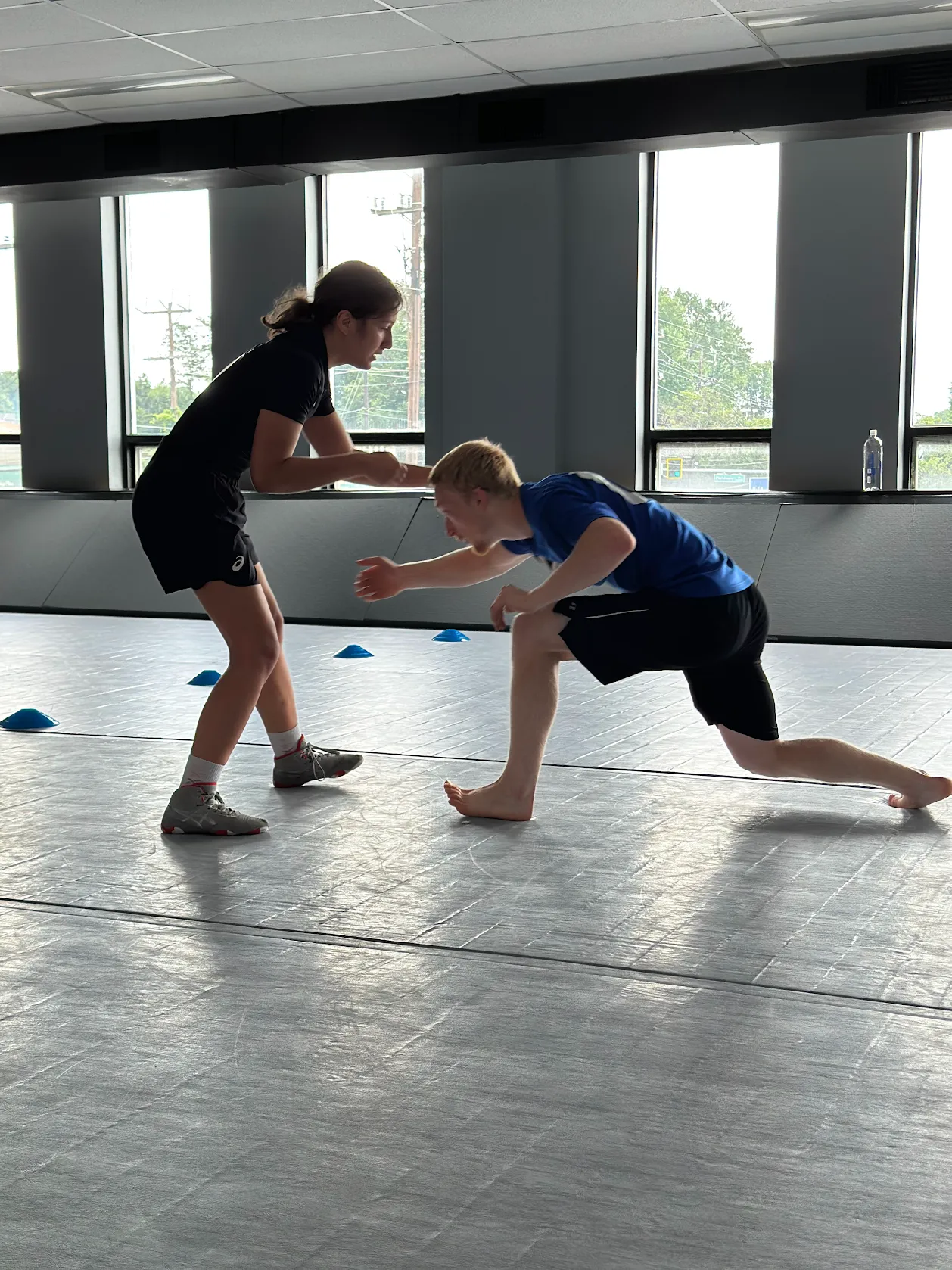
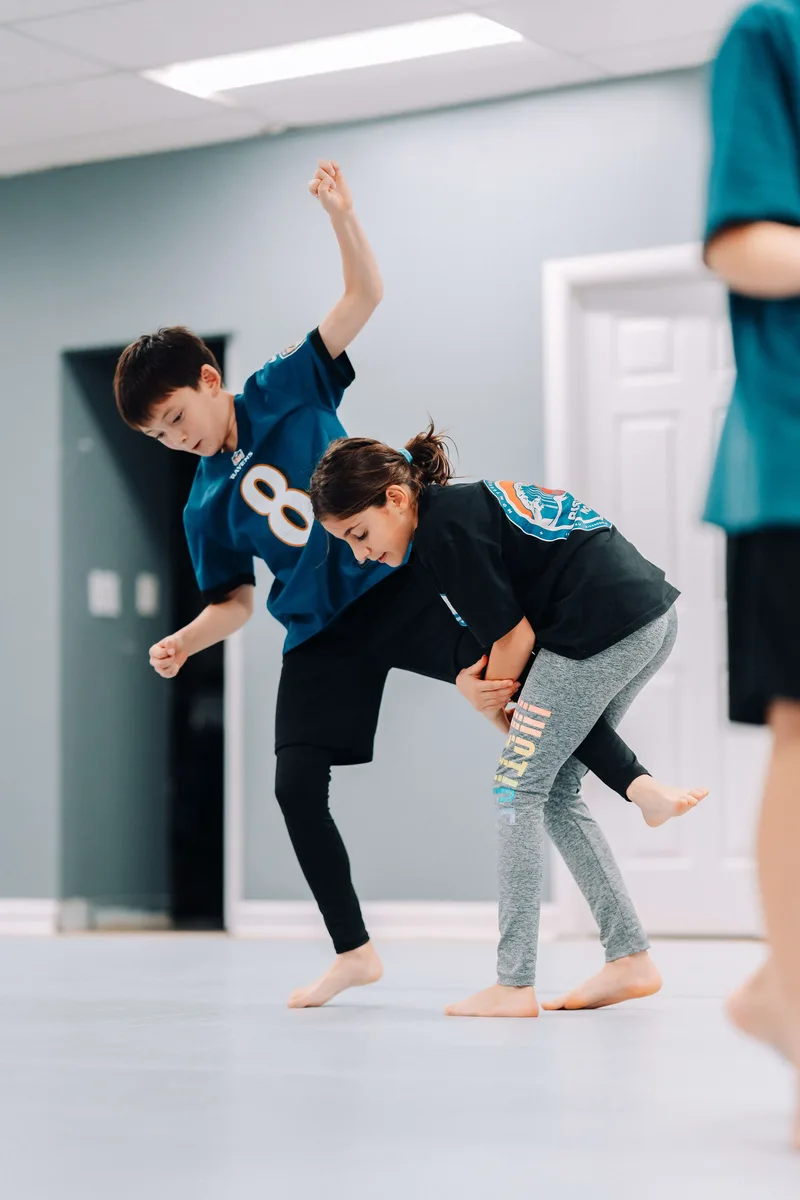
A child in a Jiu-Jitsu class "fails" dozens of times per class: they get pinned, swept, or tapped by a partner. Then they restart in five seconds and try again.
That repetition is quietly transformative. Kids learn through hundreds of low-stakes reps that failing at something is not a catastrophe — it's information. Compare that to the child who strikes out once in front of a crowd and has to wait a week for another at-bat. We wrote about that structural difference in martial arts vs team sports for kids.
3. Kids practice staying calm under physical stress
Being held down by another kid is uncomfortable. The first time, many children panic, push wildly, or cry. Over weeks, with a coach talking them through it — breathe, protect your neck, frame, turn — they learn that discomfort is survivable and solvable.
That's Bandura's fourth source in action: learning that a pounding heart doesn't mean you're about to fail. It's also why martial arts can help anxious kids in particular, something we explored in depth in martial arts for kids with ADHD and anxiety.
4. They train next to kids slightly ahead of them
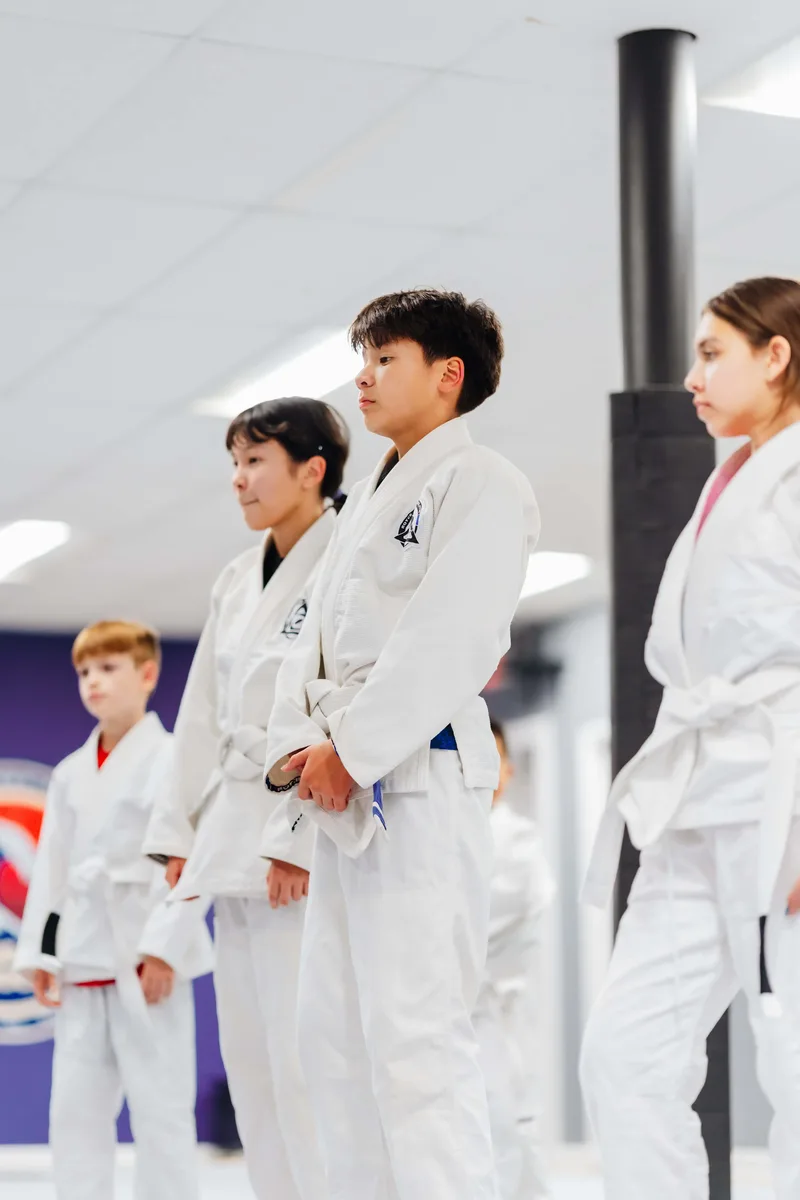
Mixed-experience classes mean every child can see a peer who's six months further along. That's a vicarious experience: she was new last year, and now she can do that. It's far more motivating than watching an adult demonstrate.
5. Feedback is specific, earned, and personal
Good coaches don't say "great job" to everyone. They say, "Maya, that's the first time you kept your elbows in on that escape." Specific, credible feedback tied to real skill is the version of praise that actually builds self-efficacy, because the child knows it's true.
Will Martial Arts Make My Child Overconfident or Aggressive?
The research above says no, and our experience agrees — with a condition. Programs that emphasize respect, control, and partner safety tend to produce kids who are less likely to start trouble, not more.
There's also a simple psychological reason: genuinely confident kids have less to prove. The kid who knows he can handle himself doesn't need to demonstrate it on the playground. Bluster usually comes from insecurity, and earned competence tends to dissolve it.
Where things go wrong is culture. A gym that celebrates hurting partners, tolerates bullying between students, or treats kids' classes like adult fight training is a bad environment regardless of the style it teaches. That's the "type of guidance" the research keeps pointing to.
What to Look For in a Kids Program
If you're evaluating programs with confidence as the goal, watch a full class and look for these:
- Every child is involved the whole class. No long lines, no kids sitting out for being "bad."
- Coaches know kids' names and correct them individually. Generic encouragement is a yellow flag.
- Promotions are tied to real skills. Ask how belts are earned. "Everyone tests every two months" is a red flag.
- Live practice is age-appropriate and controlled. Kids should experience real resistance, safely, with clear rules.
- Values are enforced, not just recited. Watch what happens when a child is rough with a partner.
- Kids are grouped sensibly by age and size. A 6-year-old and a 12-year-old shouldn't be partners.
Our full checklist for evaluating any school is in how to choose a martial arts gym.
How Long Before Martial Arts Builds Confidence in Your Child?
Every child is different, but here's a realistic pattern.
First few weeks: Comfort. Your child stops hesitating at the door, learns the routine, and starts recognizing faces.
Two to three months: The first real mastery moments — an escape that finally works, a first promotion milestone. Teachers and parents often notice small changes in focus around this point, which lines up with the three-month window in the Lakes & Hoyt study.
Six months to a year: The confidence starts showing up off the mat. Kids volunteer answers, try out for things, handle frustration better, and carry themselves differently.
The key variable is consistency. Twice a week for a year beats five times a week for a month.
What This Looks Like Here
Our kids martial arts program teaches Jiu-Jitsu, wrestling, and kickboxing to kids ages 5 to 15, grouped by age: Little Warriors (5–7) learn through play-based drills, Juniors (8–12) move into structured technique and light positional sparring, and Teens (13–15) train with more intensity and begin preparing for adult classes.
Kids Gi Jiu-Jitsu runs Monday, Tuesday, and Thursday at 5:30 PM. Kids Wrestling is Wednesday at 5:30, Kids Kickboxing is Wednesday and Friday at 6:30, Kids No-Gi Jiu-Jitsu runs Friday at 5:30, and Kids Comp Jiu-Jitsu is Saturday at 11:00 AM. Promotions are structured and based on regular skill assessments — earned, never automatic.
If you're wondering whether your child is ready, what age should kids start martial arts breaks it down by developmental stage.
We're at 5408 Randolph Road in Rockville, second floor, with free parking and a waiting area for parents. Families come from across the county — see kids martial arts near Cabin John, kids martial arts near Glen Echo, or kids martial arts near North Bethesda for directions and drive times.
The first class is free. Watch the whole thing, and judge us by the checklist above.
The Bottom Line
Martial arts builds confidence in kids the same way confidence gets built in anyone: through repeated, earned proof that hard things are possible. A good class delivers that proof on a schedule — visible progress, safe failure, calm under pressure, peers to model, and honest feedback.
The research supports it, from improved self-regulation in young children to stronger resilience and self-efficacy in teens to lower aggression across ages. But the research is also clear that how martial arts is taught decides whether those benefits show up.
Choose the coaching, not just the style. Then give it six months.
Frequently Asked Questions
Does martial arts really build confidence in kids?
Yes, when it's well taught. Randomized studies have found improvements in self-regulation, resilience, and self-efficacy in children who train martial arts compared to peers in regular PE or no program. The mechanism is earned success: kids repeatedly master difficult skills and see visible proof of their progress.
Which martial art is best for a child's confidence?
Coaching quality matters more than the style. That said, grappling arts like Jiu-Jitsu and wrestling give kids frequent, safe experience with real resistance — being pinned and escaping — which builds a particularly durable kind of confidence. Many kids benefit from a mix of grappling and striking.
Can martial arts help a shy or anxious child?
Often, yes. Martial arts lets shy kids build confidence through doing rather than talking, in a structured setting with clear rules. Anxious kids practice staying calm under mild physical stress, which can carry over to other situations. A patient coach and a gradual start make a big difference.
Will martial arts make my child more aggressive?
The research suggests the opposite. A 2017 meta-analysis of studies on youth ages 6 to 18 found martial arts training was associated with reduced aggression. Programs that emphasize respect, control, and partner safety tend to produce kids with less need to prove themselves, not more.
How long does it take for martial arts to improve a child's confidence?
Many parents notice a difference within two to three months of consistent training, typically twice a week. Larger changes — confidence showing up at school and in other activities — usually develop over six months to a year. Consistency matters more than intensity.