Two Versions of the Same Art
Walk into a Jiu-Jitsu academy on a Tuesday and you'll see people in shorts and rash guards, grabbing wrists and necks, moving fast. Walk in on a Thursday and you'll see the same people wearing heavy cotton uniforms, gripping sleeves and lapels, moving like they're playing chess underwater.
Same art. Same academy. Often the same students. Radically different feel.
The gi vs no-gi question generates more internet argument than almost anything else in BJJ, and most of it is tribal nonsense. Here's the useful version: they're two dialects of one language, they make each other better, and the one you should start with depends on why you're training.
What the Gi Actually Is
The gi (pronounced "gee," hard G) is the traditional uniform: a thick cotton jacket, reinforced trousers, and a belt that marks your rank. It's built to be grabbed — the collar, the lapels, the sleeves, and the pant legs are all deliberately reinforced because your training partner is going to be hauling on them for an hour.
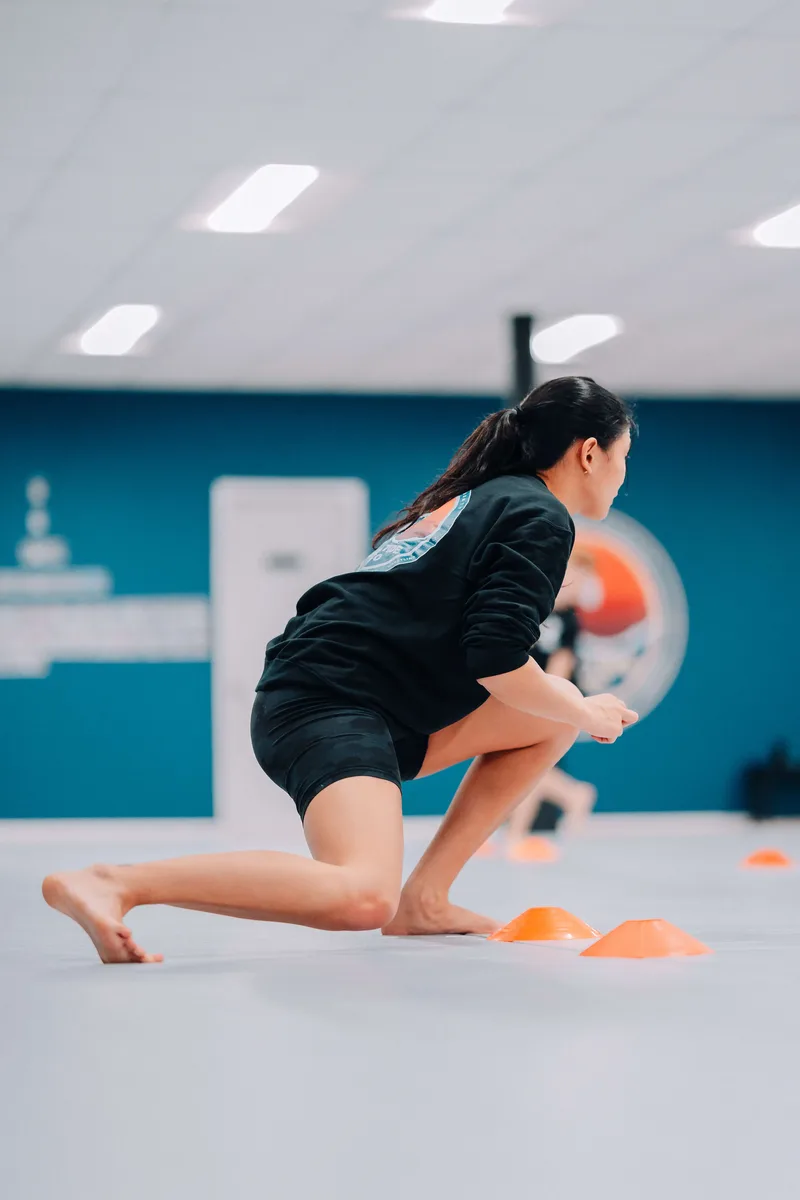
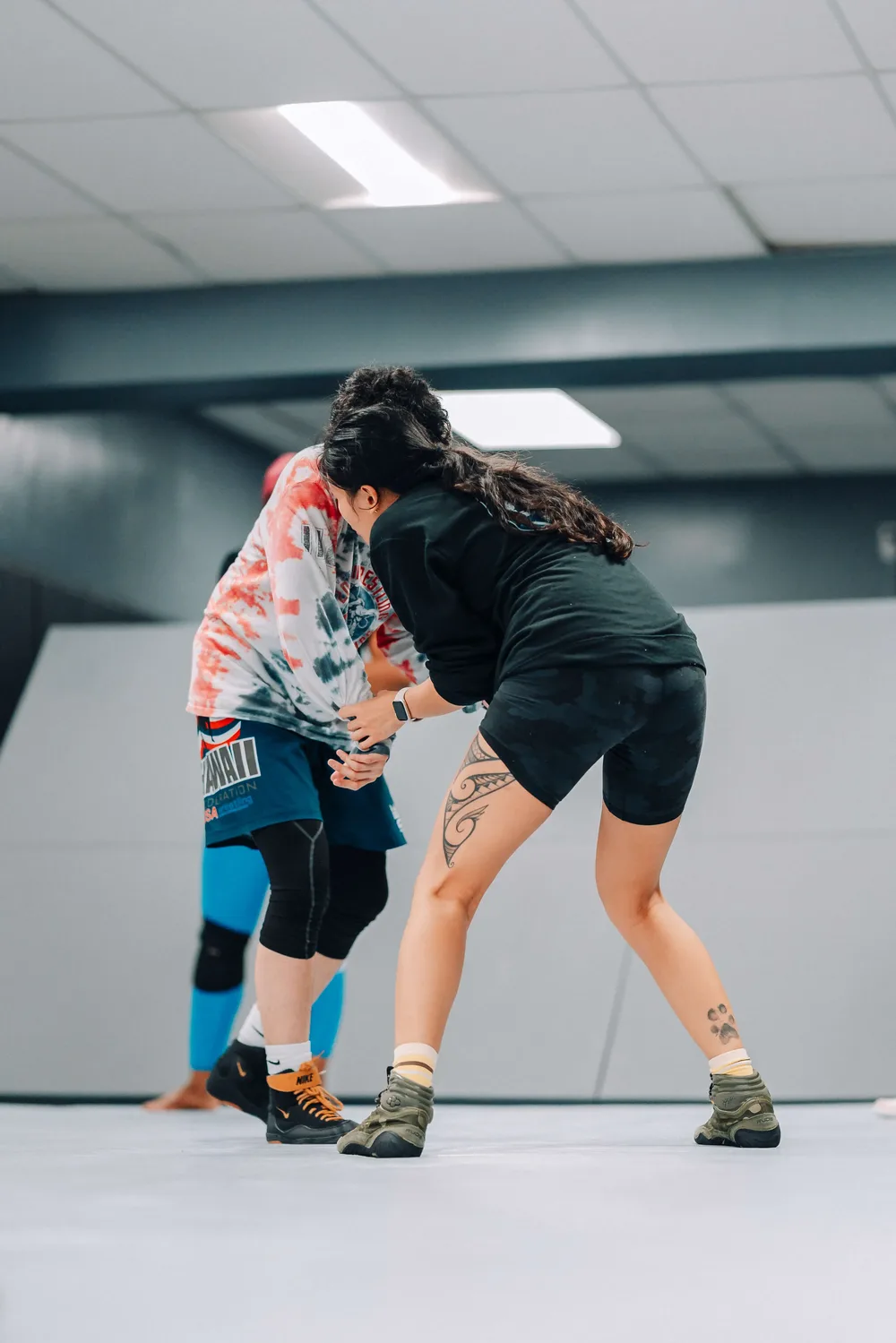
No-gi swaps that for a rash guard and fight shorts or spats. Nothing to grab except the human being inside.
That single equipment difference cascades into everything else.
The Five Real Differences
1. Grips change everything
In the gi, you have handles. You can grip a sleeve and shut down an entire arm. You can grab a collar and control someone's posture from underneath. You can hook a pant leg and stop a pass cold. There are hundreds of grip configurations, each with its own counters, and mastering them is a genuinely deep study.
In no-gi, you have wrists, necks, ankles, and body locks — and everything is slippery with sweat. Control has to come from head position, underhooks, hip pressure, and mechanical connection rather than fabric.
The consequence: gi rewards patience and precision; no-gi rewards timing and relentlessness.
2. Pace
Gi is slower. All those grips let a defender stall, frame, and shut down attacks, so positions last longer and exchanges are more deliberate. A gi round can feel like a long negotiation.
No-gi is faster. Without grips to hold anyone in place, escapes come easier, scrambles happen constantly, and rounds turn into a series of explosive transitions. It's more physically demanding in the cardio sense, and more forgiving of mistakes, because a bad position rarely lasts as long.
New students almost always find no-gi more fun early and gi more instructive early. Both perceptions are correct.
3. The submission menus differ
Gi opens up an entire category of attacks that don't exist without fabric: collar chokes, bow-and-arrow, loop chokes, ezekiel, and lapel-based control systems. There's a reason gi players are often devastating chokers — they've spent years with a rope permanently attached to their opponent's neck.
No-gi leans on the attacks that don't need cloth: guillotines, arm-in chokes, darces, anacondas, rear-naked chokes, and a far heavier emphasis on leg locks. Modern no-gi in particular has developed leg entanglement systems that most traditional gi curricula barely touch.
Everything else — armbars, triangles, kimuras, rear mount — works in both.
4. Self-defense relevance
Here's where people get dogmatic, so let's be careful.
The no-gi argument: street attackers don't wear gis, and sweat-slick control is closer to reality. True.
The gi argument: people wear jackets, hoodies, and shirts, and knowing how to use clothing as a control tool is directly transferable. Also true.
The honest answer: the fundamentals that actually keep you safe — escaping bottom positions, controlling distance, standing back up, staying calm under pressure — are identical in both. Anyone claiming one is "the real self-defense version" is defending a preference, not stating a fact. We cover what actually transfers in is BJJ good for self-defense.
5. Cost and laundry
The unglamorous practical difference. A decent gi runs $80–$150 and you'll want at least two once you're training a few times a week, because a gi that's been trained in twice without washing is a public health matter. No-gi gear is cheaper, dries faster, and packs smaller.
Nobody puts this in the philosophical debates, but it's a real factor in what people end up training.
What Each One Teaches You
If you only ever train no-gi, the common gap is defensive precision. No-gi's speed means you can often scramble out of trouble athletically rather than solving the problem technically — which works beautifully until you meet someone faster, stronger, or younger.
If you only ever train gi, the common gap is pace and scramble literacy. Gi players sometimes get comfortable holding grips and stalling, and when the fabric disappears, so does their game.
This is why most serious practitioners train both, and why the ones who do tend to improve faster than the ones who specialize early. The gi teaches you why a technique works, because you can't muscle through it. No-gi teaches you whether you can apply it when things get chaotic.
There's a useful parallel here with the grappling comparison we made in BJJ vs wrestling — different training environments expose different holes, and the fastest way to a complete game is to keep finding yours.
So Which Should You Start With?
Here's our honest recommendation, and it's not the popular internet answer:
Start with whichever class fits your schedule, then add the other within a few months.
That's genuinely the best advice for 90% of beginners, because consistency beats optimization every single time. The person who trains no-gi three times a week because it fits their calendar will outpace the person who trains gi once a week because someone online said gi builds better fundamentals.
That said, if you're choosing deliberately:
Start in the gi if:
- You want the deepest technical foundation and don't mind a slower ramp
- You're competing in IBJJF-style tournaments, where gi is the main event
- You like structure, ranks, and a traditional training culture
- You're smaller or less athletic — the gi slows things down enough to let technique win
Start in no-gi if:
- You're coming from wrestling — you'll feel at home immediately
- Your primary interest is MMA or self-defense-flavored training
- You hate the heat, which is a legitimate reason and not a soft one
- You want to feel competent faster, since fewer grips means fewer things to learn before you can participate
A note on belts: rank is awarded for Jiu-Jitsu, not for a uniform. Time on the mat counts either way at any reputable academy. If a gym tells you no-gi training doesn't count toward promotion, that's a red flag — one of several worth knowing about when you're figuring out how to choose a martial arts gym.
What Beginners Should Actually Expect
In your first month of gi training, you'll be baffled by grips. Everyone will grab your collar and you'll have no idea why it's such a problem until suddenly you can't sit up. You'll be hot. Your fingers will be sore from gripping — a genuinely underrated part of gi training that nobody warns you about.
In your first month of no-gi, everything will feel slippery and chaotic. You'll escape positions and not know how, and you'll lose positions and not know how. Your neck will be sore from headlocks and front headlock pressure.
In both, you'll be exhausted, occasionally humbled by someone half your size, and — if the gym is any good — welcomed. The full walkthrough is in what to expect at your first BJJ class, which applies to both versions.
How We Run It at Rising Tide
Our Jiu-Jitsu and wrestling program trains both, deliberately.
There's Adult Jiu-Jitsu on the mat nearly every day — 6:30 AM, noon, and evening sessions — with a dedicated Adult Gi Jiu-Jitsu class Thursday at 5:30 PM. On the women's side, the Women's Only classes alternate between no-gi on Tuesday at 6:30 PM and gi on Thursday at 6:30 PM, so you get both looks. Kids train both as well, with gi classes early in the week and no-gi on Friday and Saturday.
Friday's 7:30 PM open mat is where most people first mix the two, because open mat is where you roll with whoever's there in whatever they're wearing.
You don't need a gi to start. Come in shorts and a t-shirt, train no-gi, and if you decide you want the full experience, buy a gi when you decide — not because someone sold you one at the door.
We're at 5408 Randolph Road in Rockville, free parking out front, second floor. Members drive in from all over the county — Jiu-Jitsu near Bethesda is about a fifteen-minute run, and Jiu-Jitsu near North Bethesda is closer to eight. The Rockville martial arts page has the full program lineup if you're still deciding.
The Bottom Line
Gi is the slow, grippy, technically dense version. No-gi is the fast, slippery, scramble-heavy version. Gi will make your details sharper. No-gi will make your timing better. Neither is more "real," and the argument that one is superior is almost always someone rationalizing their own preference.
Train the one that gets you on the mat consistently. Add the other when you can. In five years you won't remember which one you started with — you'll just be a grappler.
Frequently Asked Questions
Is gi or no-gi better for beginners?
Gi teaches technical precision faster because the grips slow everything down and make it harder to muscle through mistakes. No-gi lets beginners participate meaningfully sooner because there's less to learn before you can move. Both are excellent starting points — the better answer is whichever class schedule you'll actually attend consistently.
Do I need to buy a gi to start Jiu-Jitsu?
No. Start in shorts and a t-shirt or rash guard, train no-gi for a few weeks, and buy a gi only once you know you're staying. Most academies, including ours, won't push gear on you at the door.
Does no-gi training count toward BJJ belt promotions?
At any reputable academy, yes. Rank reflects your Jiu-Jitsu — understanding, control, technical depth — not which uniform you were wearing when you learned it. Some competition-focused gyms weight gi performance more heavily, but no-gi mat time absolutely counts.
Which is better for self-defense, gi or no-gi?
The fundamentals that matter for self-defense — escaping bad positions, controlling distance, standing back up, staying calm under pressure — are identical in both. Gi adds clothing-grip skills that transfer to jackets and hoodies; no-gi better replicates sweaty, slippery control. Training both covers more ground than arguing about either.
Is no-gi harder than gi?
It's harder cardiovascularly — faster pace, more scrambles, fewer chances to rest in a controlled position. Gi is harder technically, because there are far more grip configurations and counters to learn. Most people find no-gi more tiring and gi more mentally demanding.