The Honest Answer Up Front
Is BJJ good for self-defense? Yes — Brazilian Jiu-Jitsu is one of the most effective self-defense systems a regular person can learn. But if you've been reading articles that promise Jiu-Jitsu makes you invincible, close those tabs. The real answer has nuance, and the nuance is exactly what makes BJJ worth your time.
We teach Jiu-Jitsu and wrestling every day in Rockville, and we'd rather give you the truthful version than the marketing version. Here it is.
Why BJJ Works When Other "Self-Defense" Fails
Walk into a hundred self-defense seminars and you'll see the same thing: an instructor demonstrates a technique on a partner who stands perfectly still and cooperates. Everyone practices it on their own cooperative partner. Everyone goes home feeling safer.
Nobody is safer.
The single most important fact about real physical confrontation is this: the other person does not cooperate. They resist, they panic, they grab harder than you expected, and everything you learned on a compliant partner evaporates in about one second.
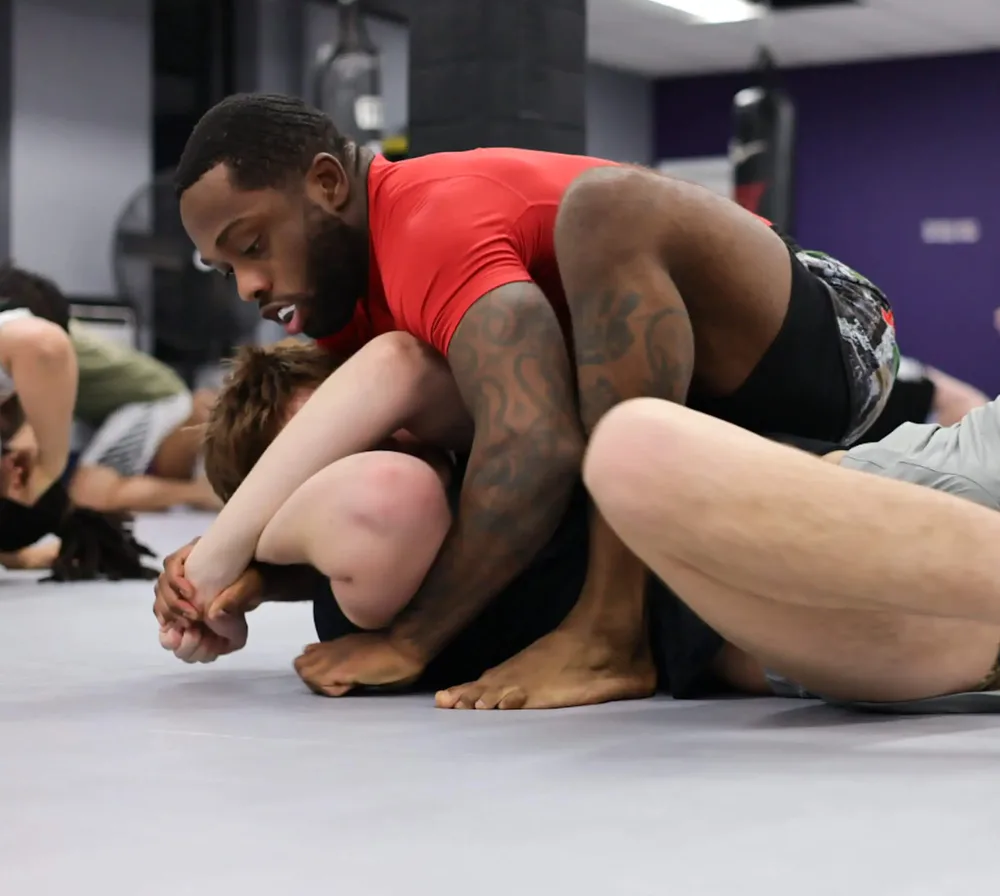
This is where BJJ is genuinely different. Jiu-Jitsu is one of the few martial arts where you practice your skills against a fully resisting partner, every single class. We call it rolling. By your third month, you will have had dozens of experiences of someone actively trying to hold you down while you work to escape — in a safe, controlled, coached environment.
That experience cannot be faked, bought, or learned from a weekend seminar. And it's the entire reason BJJ techniques hold up under stress: they've already been under stress, hundreds of times, before you ever need them.
What BJJ Teaches That Actually Matters in Self-Defense
1. The ground stops being terrifying
Most real altercations involve grabbing, shoving, and very often someone ending up on the ground. For an untrained person, the ground is the worst place on earth — pure panic. For a trained grappler, it's a known environment with known answers: protect yourself, control distance, escape, get back to your feet.
That last part deserves emphasis. Self-defense Jiu-Jitsu isn't about staying on the ground to win. It's about surviving the ground and leaving it.
2. Escapes from the grabs that actually happen
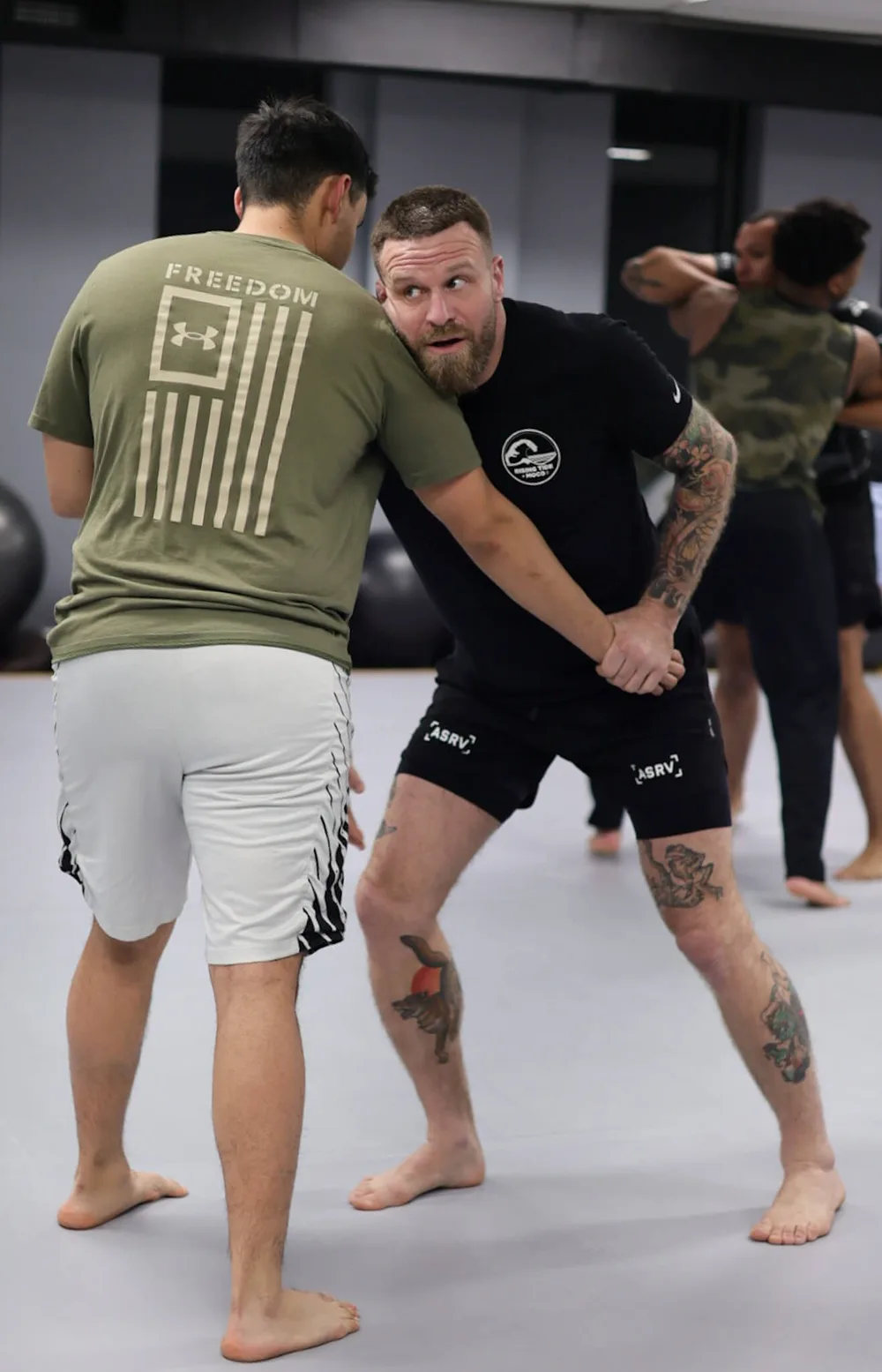
Wrist grabs, collar grabs, bear hugs, headlocks, being pinned against a wall — these are the openings of most real-world incidents, and they're bread-and-butter BJJ positions. You'll drill escapes from all of them until they're reflexes rather than memories.
3. Control without destruction
Here's a scenario nobody talks about: the drunk relative at a wedding, the out-of-line guy at your kid's game, the situation where you need to stop someone without hurting them. Striking arts give you one tool: hit harder. Jiu-Jitsu gives you the ability to control a person — hold them, neutralize them, de-escalate — without throwing a single punch. Legally and morally, that's an enormous advantage.
4. Composure under adrenaline
The first time someone pins you in training, your heart rate spikes and your brain screams. The fiftieth time, you breathe, think, and work the problem. That trained calm — what grapplers half-jokingly call comfort in bad places — transfers to every high-stress situation in your life. It might be the most valuable self-defense skill of all, because panic is what gets untrained people hurt.
What BJJ Won't Do (Read This Part)
Anyone selling you a martial art without limitations is selling you something. Here's where Jiu-Jitsu alone falls short:
Multiple attackers. Grappling one person while their friend stands nearby is a bad position no art fixes. The answer to multiple attackers is awareness, de-escalation, and running — which is why our self-defense program teaches avoidance before technique.
Weapons. No martial art reliably beats a weapon. Anyone demonstrating knife defenses with confidence should make you more skeptical, not less.
Concrete isn't a mat. Takedowns and ground work change on hard surfaces. Good self-defense-oriented training accounts for this — prioritizing staying upright, and positions that protect your head.
It won't replace judgment. The best self-defense outcome is the confrontation that never happens. Training sharpens that judgment; it doesn't substitute for it.
Notice something, though: these limitations apply to every martial art. BJJ is simply one of the few that's honest about them — and the only widely available art whose core skills are pressure-tested against full resistance from day one.
BJJ vs. Striking for Self-Defense
Should you learn to punch instead? Striking skills are valuable, and boxing footwork alone — managing distance, staying balanced — has real defensive worth.
But consider the failure modes. If your striking fails, the fight closes distance and goes to the ground, where you have nothing. If your grappling fails, you're... grappling. Still in your world. That asymmetry is why most experienced martial artists, if forced to pick one art for self-defense, pick grappling — and why the complete answer is both, which is exactly how MMA training evolved.
For most beginners we recommend starting with BJJ for the pressure-tested foundation, then adding striking once the grappling base is in place. (If you're weighing grappling styles against each other, we broke that down in BJJ vs wrestling.)
The Size Question, Answered Honestly
"Does BJJ really work against someone much bigger?" deserves a straight answer, because it's the question most people are quietly asking.
Here's the honest version: size and strength always matter. Anyone claiming technique makes them irrelevant is selling something. What Jiu-Jitsu actually does is shrink the gap — dramatically. A trained smaller person against an untrained larger person isn't a coin flip; it's a mismatch in the trained person's favor, because the untrained person has never felt real grappling resistance and has no idea what to do with their own strength once the fight leaves familiar territory.
You'll experience this from both sides in training. In your first months, smaller, more experienced training partners will handle you with frustrating ease. A year later, you'll be doing the same to bigger beginners — not because you got stronger, but because you know things their muscles can't solve. That lived experience, repeated weekly, is what makes the answer believable instead of theoretical.
What This Looks Like in Real Training
If you walked into our academy this week — whether you're five minutes away in Rockville or making the drive up Georgia Avenue from Silver Spring — here's the path you'd follow:
Weeks 1–4: fundamentals. Safe falling, basic positions, your first escapes. You'll drill with experienced partners who control the intensity. (Nervous? Read what to expect at your first BJJ class — the fear is universal and it dies fast.)
Months 2–6: the core self-defense toolkit. Escaping mount, controlling from top, breaking grips, standing back up safely. You'll start light positional rolling and discover the composure we talked about.
Month 6 and beyond: the skills become reflexes. This is the point where training stops being something you do for self-defense and becomes something you do because you love it — with self-defense as the permanent side effect.
The Bottom Line
Is BJJ good for self-defense? It's the best foundation available to a normal adult with a job and a life — not because it's magic, but because it's tested. Every technique you learn has survived thousands of reps against people genuinely trying to stop it. No seminar, no instructional video, and no cooperative-partner art can give you that.
The first class is free, beginners are the norm, and the only thing you need to bring is the willingness to be a white belt for a while.
Frequently Asked Questions
How long does it take for BJJ to be useful for self-defense?
Faster than most people think. The first layer of useful skill — escaping common grabs, protecting yourself on the ground, staying calm — develops in roughly three to six months of consistent training. You won't be an expert, but you'll be dramatically more capable than an untrained person.
Is BJJ better than boxing for self-defense?
They solve different problems. Boxing manages distance and teaches you not to flinch; BJJ owns the clinch and the ground, where most real altercations end up. If you can only pick one, grappling covers more of the failure modes. The strongest answer is training both.
Is BJJ good for self-defense for smaller people?
It's arguably the best option, because the entire art was built on the premise that leverage and technique beat size and strength. Smaller students learn to use angles, frames, and mechanics that don't depend on out-muscling anyone — which is why it anchors our women's self-defense training.
Does sport BJJ ruin self-defense skills?
Sport and self-defense BJJ overlap far more than internet debates suggest. The core skills — escapes, control, composure under resistance — are identical. A good gym keeps the self-defense context alive by training takedowns, standing back up, and awareness of strikes.
I'm out of shape. Can I start BJJ for self-defense?
Yes. You get in shape by training, not before it. Fundamentals classes scale to your level, and your only job in month one is showing up.