The Honest Answer, With the Caveat Up Front
Is kickboxing good for self-defense? Yes — genuinely, and more than most martial arts. But that answer comes with a condition that disqualifies a large share of what gets sold as kickboxing:
It has to involve contact.
If your kickboxing class consists of punching the air to a playlist, never touching a pad or a partner, and never once experiencing what it feels like when someone strikes back — that's a workout. A good one. It will not help you in a physical confrontation, and believing otherwise is worse than knowing nothing, because false confidence changes the decisions you make.
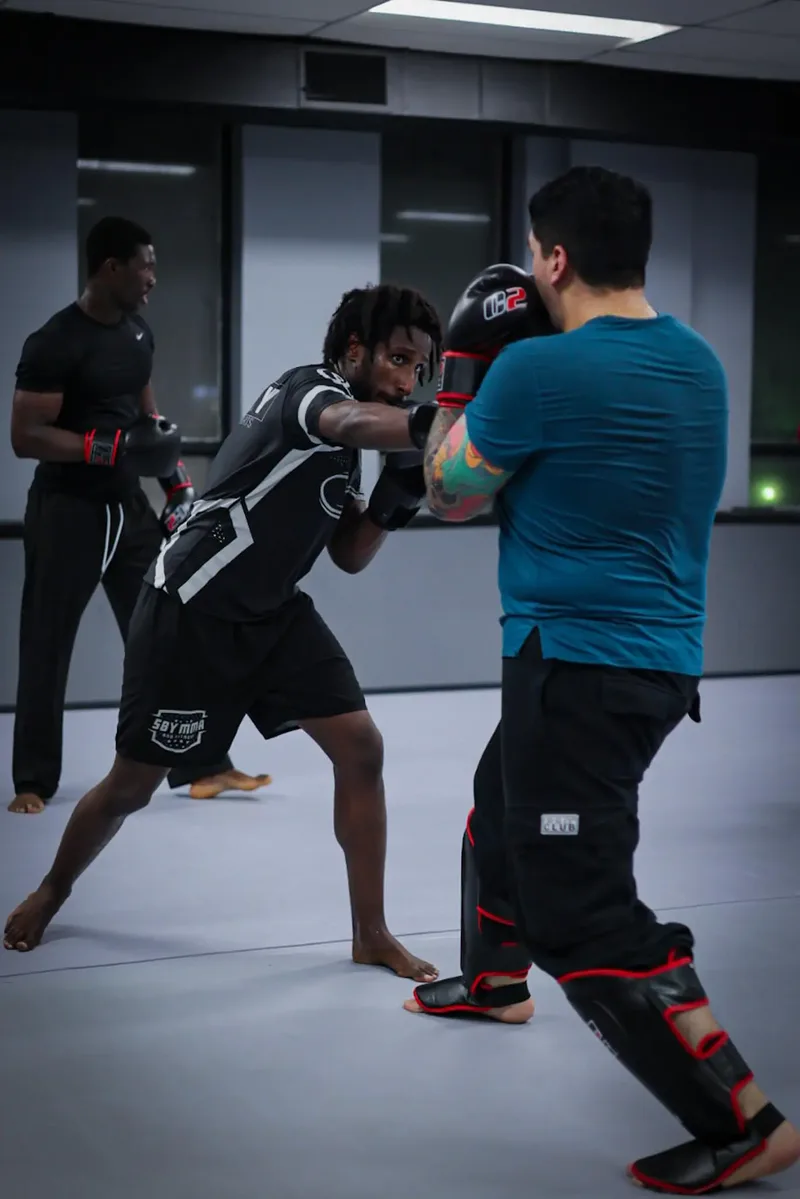
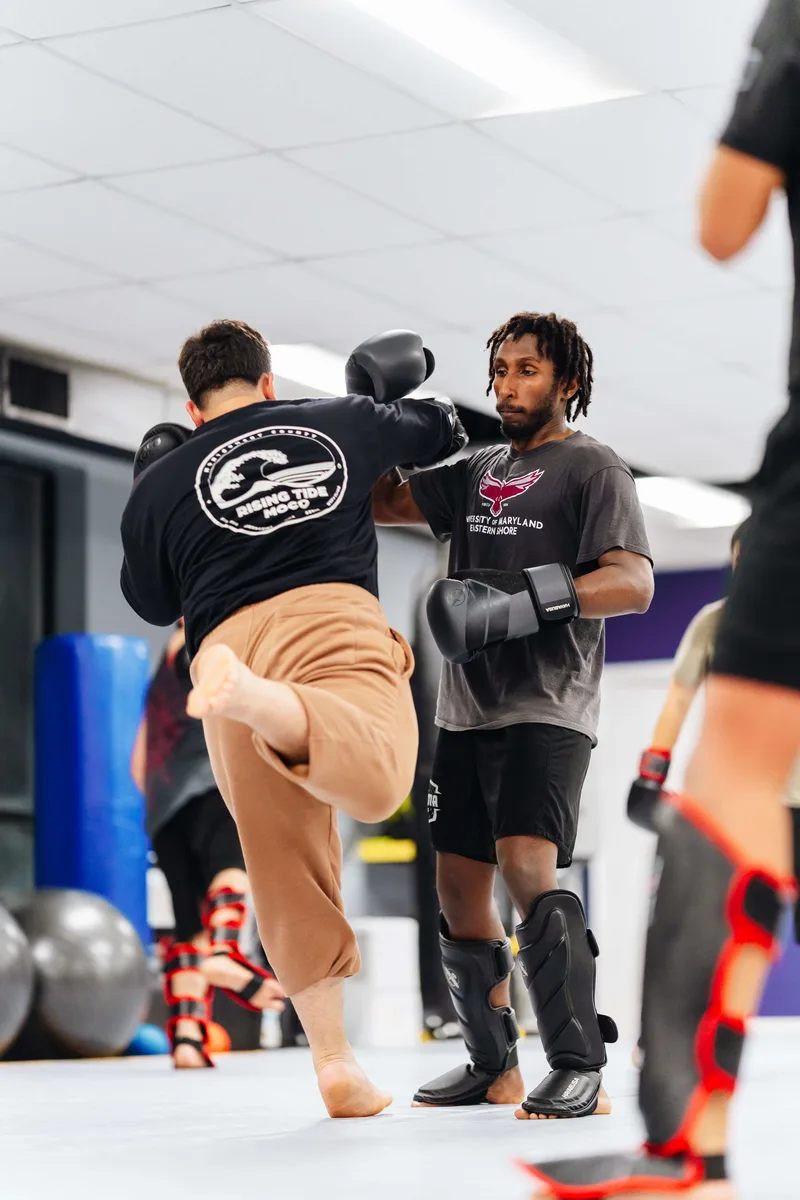
Real kickboxing — pads, bags, partner drills, and eventually controlled sparring — is a different thing entirely. That version is one of the most practically useful striking systems a normal adult can learn. Here's what it actually gives you, and precisely where it stops.
What Kickboxing Genuinely Gives You
1. Distance management — the skill that prevents fights
This is the most underrated self-defense skill in existence, and striking arts teach it better than anything else.
Trained strikers develop an automatic sense of range: who can reach you, from where, and what a step forward means. That awareness operates below conscious thought. It's why experienced fighters instinctively drift out of range when a stranger gets aggressive at a bar — not because they're planning to fight, but because their body has spent years learning what distance is safe.
Most physical altercations have a build-up. The person who unconsciously maintains distance during that build-up frequently never has a confrontation at all, and never realizes how close it came.
2. You stop flinching
Here's something almost nobody thinks about until it matters.
The untrained response to something coming at your face is to shut your eyes, turn your head away, and freeze — for maybe half a second. Half a second is an eternity. Almost every one-punch knockout you've seen happened to someone who never saw it coming because they'd already looked away.
Kickboxing trains this out of you methodically. Pad work, partner drills, and light sparring gradually rewire the reflex from close eyes and turn to keep eyes open, hands up, move. You cannot get this from shadowboxing alone, from videos, or from a seminar. It requires things actually coming toward your face, at increasing speed, over months.
3. Real power, generated correctly
Untrained people hit with their arms. It doesn't work particularly well.
Kickboxing teaches force generation through the kinetic chain — foot, hip, torso, then hand or shin. The difference is enormous, and it's the great equalizer for smaller people. A 140-pound person with two years of proper striking hits considerably harder than a 200-pound person who's never trained.
You also learn what not to do: no more wild haymakers that leave you off balance and exposed, no more broken hands from punching with bad structure.
4. Conditioning under adrenaline
A genuine physical confrontation is astonishingly exhausting. Adrenaline burns through an untrained person's gas tank in about twenty seconds, after which they are functionally helpless.
Round-based training builds the specific kind of conditioning that holds up when your heart rate spikes and your hands shake. That's not a fitness benefit — it's a survival one.
5. Composure, if you spar
If you eventually take controlled sparring, you get the thing seminars can never provide: experience being under real pressure while a person who isn't cooperating tries to hit you. The first few times, your technique will evaporate. By the twentieth time, you'll be thinking clearly.
That transfer is the entire reason pressure-tested arts outperform demonstration-based ones — and it's the same argument we made about grappling in is BJJ good for self-defense.
Where Kickboxing Runs Out
Anyone selling you a martial art without limitations is selling you something. Here are kickboxing's, honestly.
The clinch. Real fights close distance fast. Once someone has grabbed your shirt, wrapped you up, or shoved you against a wall, your striking range is gone. Kickboxing that includes clinch work (Muay Thai-influenced) handles this better; pure point-style kickboxing barely addresses it.
The ground. This is the big one. A substantial share of real altercations end up on the ground, whether through a takedown, a trip, or two people simply falling. On the ground, a striker with no grappling has essentially nothing — and the ground is where size and strength advantages become most decisive.
This isn't a knock on kickboxing specifically; it's an honest statement about what striking arts cover. It's also exactly why MMA evolved the way it did.
Multiple attackers and weapons. No martial art solves either. Grappling one person while their friend is nearby is a bad position; a knife beats a trained striker as reliably as it beats an untrained one. The answers here are awareness, de-escalation, and leaving — which is why our self-defense program puts avoidance ahead of technique.
The legal and moral problem. This one gets skipped constantly and deserves attention.
Striking is designed to injure. If you knock someone down and they hit their head on concrete, the consequences are severe and permanent — for them and legally for you. In many real situations (an aggressive drunk relative, a shoving match that got out of hand, someone you don't actually want to hurt), the correct response is to control the person, not damage them.
Striking gives you exactly one tool: hit harder. Grappling gives you options that include restraint. That's a genuine argument for grappling as a self-defense base, and an honest kickboxing coach will tell you so.
Kickboxing vs BJJ for Self-Defense
The internet treats this as a rivalry. It's really a question about failure modes.
If your striking fails, the fight closes to the clinch and often to the ground — where, without grappling, you have nothing.
If your grappling fails, you're... still grappling. You're in your own domain, in a bad spot, with tools.
That asymmetry is why, if forced to pick exactly one art for self-defense, most experienced martial artists pick grappling. It covers more of the ways things go wrong.
But that framing undersells kickboxing badly, because kickboxing covers a phase grappling doesn't: everything before contact. Distance, the flinch response, and the ability to create space and leave are striking skills, and no amount of Jiu-Jitsu develops them.
For women specifically, we've argued the grappling case in women's self-defense: why Jiu-Jitsu is the best option — the leverage-over-strength argument is compelling. But striking has a place there too: keeping distance from someone who's closing in is a skill worth having before the leverage question comes up.
The complete answer is both. It always has been.
How to Tell If Your Kickboxing Class Counts
Ask these five questions. They separate self-defense-relevant training from expensive cardio:
- Do students hit pads and heavy bags, or only the air? Air-only is fitness.
- Is there partner work? Working with a human who reacts is where timing lives.
- Is there controlled sparring available for students who want it? Not mandatory, but it must exist as a path.
- Do coaches correct individual technique? Or does the instructor face a mirror and count?
- Does anyone mention what kickboxing doesn't cover? An honest coach acknowledges the ground. A coach who tells you kickboxing handles everything is not a good source of information.
If the answers are yes, yes, yes, yes, and yes, you're training something real. If they're mostly no, you're doing aerobics with better music — worthwhile for fitness, useless for defense. This screening is the same instinct we described in how to choose a martial arts gym, applied to striking.
A Realistic Timeline
Months 1–3. Stance, basic punches and kicks, and the beginnings of the flinch rewiring. You're not dangerous yet, but you're already more aware of distance than you were.
Months 4–8. Power generation clicks. Combinations become automatic. Conditioning improves substantially. If you've started light sparring, you're learning what pressure feels like.
Year 1–2. Genuinely capable against an untrained aggressor at striking range. Composed under pressure. Aware enough that you're likely avoiding situations you'd previously have walked into.
Note what's absent from that timeline: any point at which you become untouchable. The best self-defense outcome remains the confrontation that never happens, and training sharpens the judgment that produces that outcome without ever replacing it.
How We Train It
Our boxing and kickboxing classes are technique-first and contact-based, not cardio theater. Adult Kickboxing runs Monday at 9:00 AM, Tuesday and Thursday at 7:30 PM, and Saturday at 10:00 AM. Friday at 7:30 PM is Boxing/Kickboxing Sparring for members who've built the foundation and want the pressure — entirely optional, always supervised.
Because we're a full martial arts academy rather than a striking-only gym, the gap gets covered too. Members who train kickboxing frequently add Jiu-Jitsu, and our self-defense classes address awareness, de-escalation, and what happens when distance collapses. That combination is the honest answer to the question this article asks. If you're deciding where to begin, boxing vs. kickboxing breaks down the striking side.
We're at 5408 Randolph Road in Rockville, second floor, free parking. Adults drive in from all over the county — see boxing and kickboxing near Aspen Hill, self-defense classes near Silver Spring, or the Rockville martial arts page for the full lineup and directions.
First class is free, and nobody will hit you in it.
The Bottom Line
Kickboxing is genuinely good for self-defense — provided it involves contact. It delivers the four things that matter most before a fight starts: distance awareness, a trained flinch response, real power, and conditioning that survives adrenaline.
What it doesn't cover is the clinch and the ground, where a large share of real altercations end up, and it gives you no option between "do nothing" and "hurt someone." Those are real gaps, not minor ones.
Train kickboxing for what it's excellent at. Add grappling for what it isn't. And remember that every hour spent on awareness and de-escalation outperforms every hour spent on technique, because the fight you avoid is the only one you're guaranteed to win.
Frequently Asked Questions
Is kickboxing or boxing better for self-defense?
Kickboxing has a slight edge — kicks add range, and leg kicks are effective at creating distance. But boxing's superior head movement and hand speed matter more at close range, where most confrontations actually happen. The difference is small; the difference between either one with contact training and either one without it is enormous.
Is cardio kickboxing good for self-defense?
No. Cardio kickboxing is a fitness class — no contact, no partner work, no pressure. It's excellent exercise and builds coordination, but striking air never teaches distance, timing, or the flinch response. If self-defense is your goal, find a class with pads, bags, and partners.
How long until kickboxing is useful for self-defense?
The awareness and distance-management benefits begin within weeks. Meaningful striking capability against an untrained aggressor takes roughly six months to a year of consistent training. Composure under real pressure requires sparring, which typically starts several months in.
Is kickboxing enough on its own for self-defense?
It covers the standing phase well and the ground phase not at all. Since a substantial share of real altercations end up in a clinch or on the ground, kickboxing alone leaves a significant gap. Pairing it with grappling — Jiu-Jitsu or wrestling — covers far more of what can actually go wrong.
Is kickboxing good for self-defense for women?
Yes, particularly for the distance skills — recognizing when someone is closing range and creating space to leave. That said, if an attacker gets hold of you, grappling skills become more directly applicable, which is why many women train both. Neither replaces awareness and de-escalation as the first line of defense.