The Fear Nobody Says Out Loud
Almost everyone who walks into their first boxing class is quietly worried about the same thing: am I going to get hit?
Here's the answer, straight away — no. Not on day one, not in week one, and not until you decide you want to. At any gym worth training at, sparring is opt-in, supervised, and months away. Your first boxing class is about learning to stand, move, and throw a punch correctly. Nobody is going to test your chin.
With that out of the way, let's talk about what actually happens — because the real surprises of a first boxing class have nothing to do with getting punched.
Before You Walk In
What to wear: athletic shorts or leggings, a t-shirt, and clean athletic shoes. That's it. No special gear, no uniform, nothing to buy.
What to bring: water and a small towel. If you own hand wraps and gloves, bring them. If you don't, don't buy them yet — most gyms, including ours, have loaner gloves for your first classes. Train a few times before you spend money on equipment, because the gloves you think you want and the gloves you actually want are usually different.
When to arrive: ten to fifteen minutes early. This isn't just politeness. You'll need time to sign in, meet the coach, and get your hands wrapped — and wrapping is a skill you don't want to be rushing through while class is starting.
What to eat: something light, ninety minutes or so beforehand. Boxing conditioning is more demanding than most people expect, and training on a full stomach is a lesson you only need to learn once.
The First Fifteen Minutes: Wrapping Up
Hand wraps look decorative. They're not. They compress the small bones of your hand and support your wrist so that hitting a heavy bag doesn't rearrange your knuckles.
Someone will show you how to wrap. You will do it badly. Everyone does it badly for about two weeks — too loose, too tight, bunched across the knuckles, forgetting the thumb loop. Nobody cares. Ask a coach or the person next to you to check it before you hit anything, and by your fourth or fifth class it'll take you ninety seconds without thinking.
This is also the part of class where you'll notice something that surprises most newcomers: boxing gyms are friendly. The movies sold you a room full of glowering tough guys. The reality is a room full of accountants, nurses, and software engineers who found out that hitting things is an excellent way to feel human again.
The Warm-Up That Humbles Everyone
Here's the actual hard part of your first boxing class, and it isn't the boxing.
Expect ten to fifteen minutes of jump rope, shadowboxing, footwork drills, and calisthenics. Boxing conditioning targets your shoulders, your calves, and your lungs in a very specific way that running and lifting simply do not prepare you for.
Two things will surprise you:
Your shoulders will burn before anything else. Holding your hands up next to your face — just holding them there — is a static endurance test that most adults have never trained. Three rounds in, your arms will feel like they're full of wet sand. This is universal and it improves fast.
Jump rope is much harder than you remember. You were eight years old the last time you did this. Your coordination will be embarrassing for about three sessions, then it'll click, and then you'll catch yourself doing it well and feel unreasonably pleased with yourself.
If you can't finish the warm-up on day one, you're not failing. You're establishing a baseline. Sit a round out, drink water, get back in. No coach worth their salt will think less of you — the ones who would aren't coaches we'd recommend, which is a big part of how to choose a martial arts gym in the first place.
Learning the Stance (The Part Nobody Warns You About)
Now the technical work begins, and here's the thing nobody tells beginners: your first boxing class is mostly about your feet.
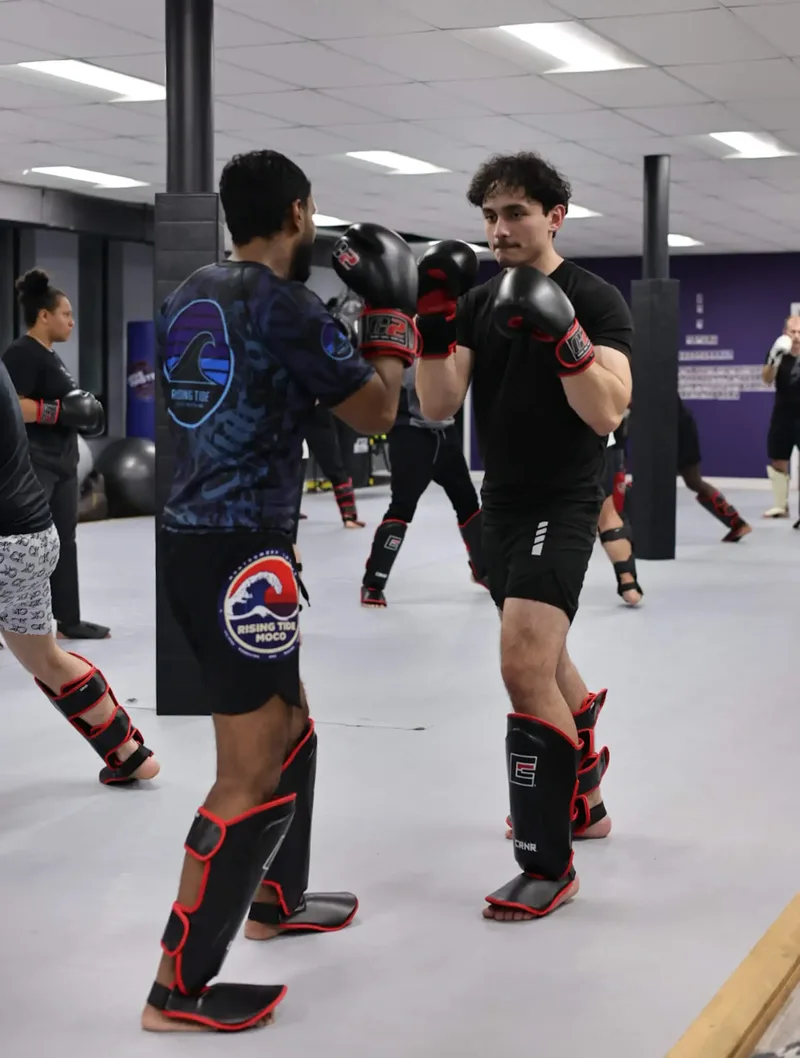
You'll spend real time on stance — which foot forward, how wide, weight distribution, chin tucked, elbows in, hands up. Then you'll learn to move in that stance without crossing your feet or bouncing off balance.
It feels awkward. It feels like the least glamorous possible use of your time. It is also the single reason trained boxers look completely different from untrained ones, because power in boxing comes from the ground up through your hips — not from your arms. A jab thrown with correct footwork from a stable base will hit harder than a haymaker thrown by someone twice your size with no structure.
Then come the punches, usually in this order:
- The jab — your lead hand, straight out and straight back. The most important punch in boxing and the one you'll drill for years.
- The cross — your rear hand, turning your hip and pivoting your back foot.
- The hook — a bent-arm punch that comes around the side.
That's usually enough for a first class. If a gym tries to teach you six punches, four defensive movements, and a combination on your first night, they're performing rather than teaching.
Hitting Things (Finally)
Somewhere in the second half of class you'll get to the heavy bags or mitts, and this is the part everyone actually came for.
Be ready for a small letdown followed by a big high. The letdown: your first punches on the bag will feel weak and awkward, and the bag will barely move. The high: about eight minutes later, you'll land one that connects properly through your hips, feel the whole chain fire from your back foot to your knuckles, and hear the bag make a completely different sound.
That moment is why people stay.
A few practical notes:
- Start at 50% power. Your wrists and knuckles need conditioning that takes weeks. Going full force on day one is the fastest route to a sore wrist and a two-week layoff.
- Breathe out on every punch. Beginners hold their breath and gas out in ninety seconds. Short sharp exhale, every shot.
- Rounds are three minutes. They are much longer than three minutes.
If your gym runs partner mitt work, you may hold pads for someone more experienced. Don't panic — they'll walk you through it, and honestly, holding mitts teaches you distance and timing faster than anything else.
Will You Spar?
No.
Sparring at a responsible gym requires competent defense, controlled power, and a coach's explicit invitation. That's typically several months of consistent training away, and plenty of people train for years without ever sparring — they come for the fitness, the skill, and the stress relief, and that's a completely legitimate way to box.
When sparring does eventually happen, it starts light, technical, and heavily supervised. It is not a fight. It's a conversation with gloves on.
The Soreness Is Real (Here's Where)
Expect to be sore in places you didn't anticipate:
- Shoulders and upper back — from holding your guard, not from punching
- Obliques and core — every punch rotates through your midsection
- Calves — from staying on the balls of your feet
- Lats — from retracting punches, which is the half of punching nobody thinks about
Your knuckles may be tender for a day or two. Your hands should not hurt — if they do, your wraps were wrong or you swung too hard, and both are fixable.
Peak soreness lands about 48 hours out. Come back anyway. The second class is meaningfully easier than the first, and the fourth is where it stops feeling like an experiment and starts feeling like something you do.
What Boxing Looks Like Long-Term
Most people arrive for the workout and stay for the skill. Six weeks in, you'll notice your balance is better, your posture has changed, and you've stopped flinching. Three months in, the combinations that felt impossible are automatic, and you'll start seeing why boxers describe the sport as physical chess.
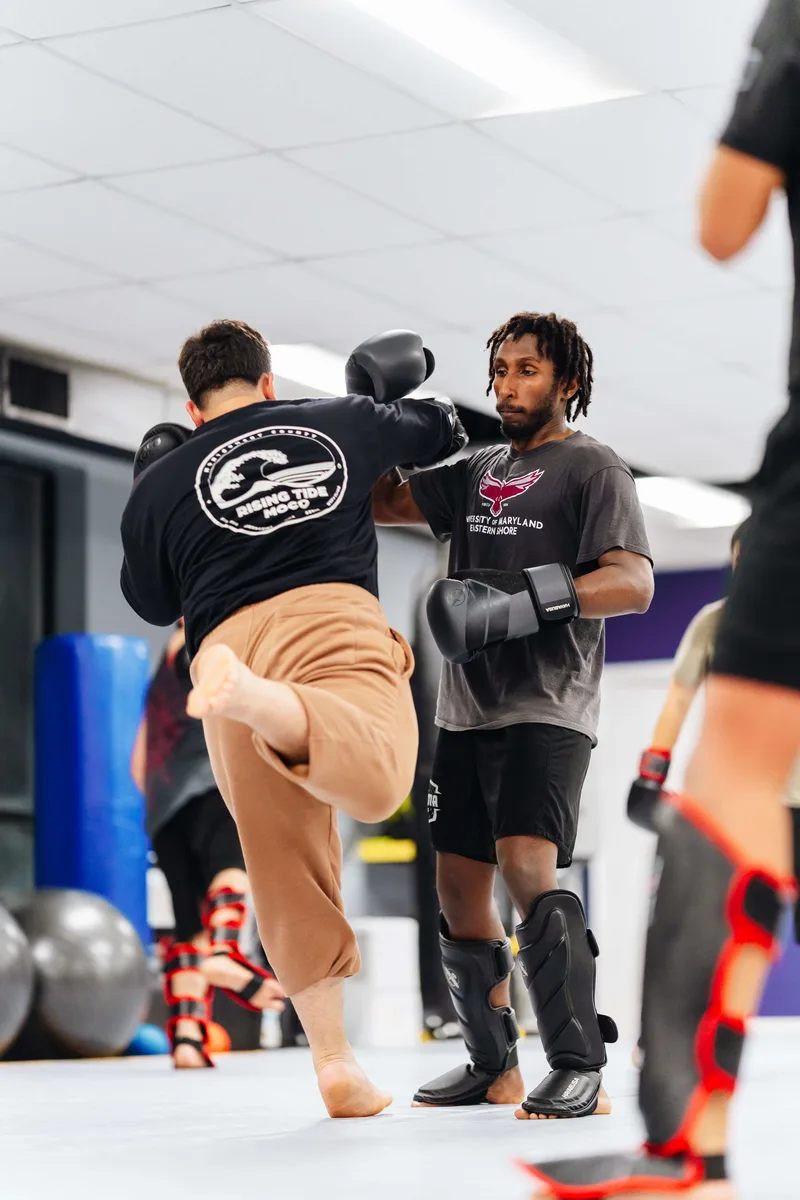
You'll also have to answer a question we get constantly: should you add kicks? We broke down the full comparison in boxing vs. kickboxing, but the short version is that plenty of members train both — our boxing and kickboxing program runs them on complementary nights, so you don't have to choose.
Practical Details for Your First Class
We're at 5408 Randolph Road in Rockville, on the second floor, with free parking out front. Adult Boxing runs Monday and Wednesday evenings at 7:30, plus Tuesday and Friday mornings at 9:00 — and Friday night at 7:30 is Boxing/Kickboxing Sparring for members who've built up to it.
If you're driving in from elsewhere in the county, we've mapped the routes: boxing and kickboxing near North Bethesda is an eight-minute drive up Rockville Pike, and boxing and kickboxing near Bethesda runs about fifteen. If you'd rather see the whole picture first, the Rockville martial arts page lays out every program under one roof.
Your first class is free. Not a trial offer with strings — genuinely free, no obligation, no contract conversation on the way out.
The Bottom Line
Your first boxing class will be harder than you expect in ways you didn't expect, and easier than you feared in exactly the way you feared. Nobody will hit you. Your shoulders will complain. You'll wrap your hands badly, throw about a hundred jabs, land one perfect punch, and leave sweating and slightly addicted.
Wear shorts, show up early, and start at half power. That's the whole preparation list.
Frequently Asked Questions
Do I need to be in shape before my first boxing class?
No — and waiting until you're "ready" is the single most common reason people never start. Classes scale to your level, you can sit out a round whenever you need to, and boxing conditioning is so specific that even experienced gym-goers find their first class humbling. You get in boxing shape by boxing.
Will I get punched at my first boxing class?
No. Sparring is opt-in, requires a coach's approval, and typically comes months into training if you want it at all. Your first class is footwork, technique, bag work, and conditioning.
What should I wear to a boxing class?
Athletic shorts or leggings, a t-shirt, and clean athletic shoes. Bring water. Hand wraps and gloves are useful, but most gyms lend gloves to beginners — wait a few classes before buying your own.
How sore will I be after my first boxing class?
Sore, but not injured. Expect shoulders, core, calves, and lats to speak up for a day or two, peaking around 48 hours. Tender knuckles are normal; actual hand pain means your wraps or your power level need adjusting.
How long before I look like I know what I'm doing?
Around six to eight weeks of training twice a week, your stance and jab will look genuinely trained. The three-month mark is when combinations start flowing without conscious thought — and that's where the sport gets addictive.