The Short Answer
The difference between Muay Thai vs kickboxing comes down to range. Muay Thai uses eight weapons — fists, elbows, knees, and shins — and fights extensively in the clinch, where two people are tied up at close quarters. Most kickboxing rule sets drop the elbows, limit the clinch, and fight at punching-and-kicking distance with more emphasis on fast hand combinations.
Everything else — the stance, the rhythm, how kicks are set up, how fights are scored — flows from that one decision about range.
Both are excellent. Both will get you in serious shape and teach you to hit hard. But they are not the same art, and if you know what each one emphasizes, you can pick a gym based on what you actually want instead of whichever word is on the sign.
Muay Thai vs Kickboxing at a Glance
| Muay Thai | Kickboxing (Dutch / modern rules) | |
|---|---|---|
| Weapons | Fists, elbows, knees, shins (8 limbs) | Fists, shins, knees (elbows usually banned) |
| Clinch | Central — long exchanges of knees, off-balancing, and sweeps | Limited — usually broken up quickly by the referee |
| Stance | Taller, more square, weight back to check kicks | Lower and more bladed, built for punching combinations |
| Hands | Fewer, heavier punches | High-volume boxing combinations |
| Kicks | Power roundhouse and teep, often thrown on their own | Kicks set up by punches, classically ending in a low kick |
| Pace | Slower start, builds across five rounds | Higher pace from the opening bell |
| Scoring | Rewards kicks, knees, balance, and visible effect | Rewards volume, aggression, and damage |
| Best fit | Clinch-heavy self-defense, MMA striking, tradition | Combination striking, hand-heavy fitness, modern competition |
That table is the quick version. Here's what each line actually means on the mat.
What Muay Thai Is
Muay Thai is Thailand's national sport, often called "the art of eight limbs" because it uses eight points of contact: two fists, two elbows, two knees, and two shins.
Traditional Muay Thai fights run five three-minute rounds, and the culture around them is deep — the pre-fight wai kru ritual, the ringside music, the scoring philosophy. Judges in Thailand reward clean technique, balance, and visible effect far more than raw volume. A fighter who lands a hard body kick and stays perfectly balanced has often won that exchange, even if the other fighter threw more punches.
The defining feature for most Western students is the clinch. Muay Thai fighters spend a large share of every fight tied up at close range, fighting for neck and arm control, landing knees, and trying to off-balance or dump their opponent to the canvas. That clinch is a skill set of its own, and most striking arts barely address it.
What "Kickboxing" Actually Means
Here's where people get confused: kickboxing isn't one martial art. It's an umbrella term for several striking systems that combine punches and kicks.
American kickboxing grew out of full-contact karate in the 1970s. Early rule sets restricted kicks below the waist, which produced a style heavy on boxing and high kicks.
Dutch kickboxing developed in the Netherlands in the '70s and '80s, when gyms blended Kyokushin karate, Western boxing, and Muay Thai into something new: relentless punching combinations that finish with a hard low kick. It became one of the most successful competitive styles in the world, and it's the DNA of most modern kickboxing.
Modern international rule sets — the kind you'd see in K-1 or Glory — typically allow punches, kicks, and knees, ban elbows, and sharply limit clinching. Grab your opponent and the referee breaks you apart almost immediately.
So when someone asks about Muay Thai vs kickboxing, they're usually comparing Muay Thai to the Dutch-influenced style that dominates modern kickboxing. That's the comparison we'll use.
The Five Differences That Matter in Training
1. Elbows (and how often you'll use knees)
Muay Thai trains elbows as a primary weapon — short, sharp strikes that do enormous damage at a range where punches barely fit. Most kickboxing competition bans them, so many kickboxing gyms spend little time on them.
Knees exist in both, but in Muay Thai they're thrown constantly from the clinch. In modern kickboxing they're mostly a single strike thrown before the referee separates you.
2. The clinch
This is the biggest practical difference between the two. Muay Thai students learn to fight for head and arm control, knee from the clinch, turn an opponent, and dump them off balance. A Muay Thai gym will regularly run entire rounds of clinch work.
In most kickboxing rule sets, the clinch barely exists. That frees kickboxers to focus on footwork and combinations, but it leaves a gap — and for self-defense, it's a meaningful one. Real confrontations close distance fast, and someone grabbing your shirt is far more common than someone squaring up to trade combinations.
3. Stance and rhythm
Muay Thai fighters stand taller and more square, with weight shifted to the back leg so the lead leg is light enough to lift and check incoming kicks. They move with a distinctive rhythmic bounce, and traditional fights start slowly, building intensity through the middle rounds.
Kickboxers stand lower and more bladed — closer to a boxer — because their offense leans on fast hand combinations. The pace is higher from the opening bell.
4. How kicks are thrown and set up
Both arts kick with the shin, not the foot, and both turn the hip over for power. The difference is mostly in the setup.
A Muay Thai fighter might throw a single, full-power roundhouse kick on its own and dare you to check it. A Dutch-style kickboxer hides the kick behind punches: jab, cross, hook, then the low kick, landing while you're still thinking about the hands. Muay Thai also leans heavily on the teep (push kick) as a jab with the leg, used to manage distance and break rhythm.
Muay Thai allows catching kicks and sweeping the standing leg, which adds a layer of tactics that kickboxing rule sets usually limit.
5. Scoring and pace
Because Muay Thai judges reward effect and balance, fighters are patient and deliberate. Kickboxing rewards volume and aggression, so fighters push the pace and throw more.
For a recreational student who'll never compete, this mostly shows up as the feel of a class: Muay Thai classes often include long, technical clinch rounds; kickboxing classes often feel faster and more combination-heavy.
Muay Thai vs Kickboxing: Which Should You Train?
The honest answer depends on your goal.
For fitness and weight loss: Either one. Both deliver some of the most demanding conditioning in any sport. Hand-heavy kickboxing classes tend to feel slightly more cardio-intensive minute to minute; Muay Thai's clinch work builds grip, neck, and core strength that bag work doesn't. We broke down the real numbers in kickboxing calories burned.
For self-defense: Muay Thai's clinch work gives it the edge. The ability to control someone who has grabbed you — and to knee your way out — covers a phase of real confrontations that pure combination striking doesn't. We wrote a full breakdown in is kickboxing good for self-defense, including where all striking arts run out.
For MMA: Muay Thai-style clinch work and elbows translate directly to the cage, which is why most MMA striking borrows heavily from it. Dutch-style combinations and low kicks translate too. In practice, MMA fighters use a blend of both — plus wrestling, because every exchange happens with the threat of a takedown.
For competition: Pick the rule set you want to compete under and train for it specifically. Local amateur Muay Thai and kickboxing events both exist, and the preparation diverges at that level.
For a complete beginner who isn't sure: It genuinely doesn't matter much for your first year. A good jab, a correct roundhouse kick, a sound guard, and solid footwork are the same in both. Choose the gym, not the label.
Why the Label Matters Less Than the Gym
Here's the part most comparison articles skip: the name on the class schedule tells you less than the way the class is run.
Plenty of gyms with "Muay Thai" on the sign never teach the clinch. Plenty of "kickboxing" classes are cardio sessions where nobody ever hits a pad held by a human being. And many of the best striking coaches teach a hybrid anyway, borrowing what works from both traditions.
When you visit a gym, ask:
- Do students hit pads held by a coach or partner, not just bags and air?
- Is clinch work part of the curriculum?
- Is there controlled sparring available for students who want it — and is it optional?
- Do coaches correct individual technique, or just call out combinations?
Those answers tell you more than whether the sign says Muay Thai or kickboxing. If you're comparing gyms, how to choose a martial arts gym walks through the rest of the checklist.
And if you're still deciding whether you want kicks at all, boxing vs. kickboxing covers that choice.
How We Teach Striking at Rising Tide
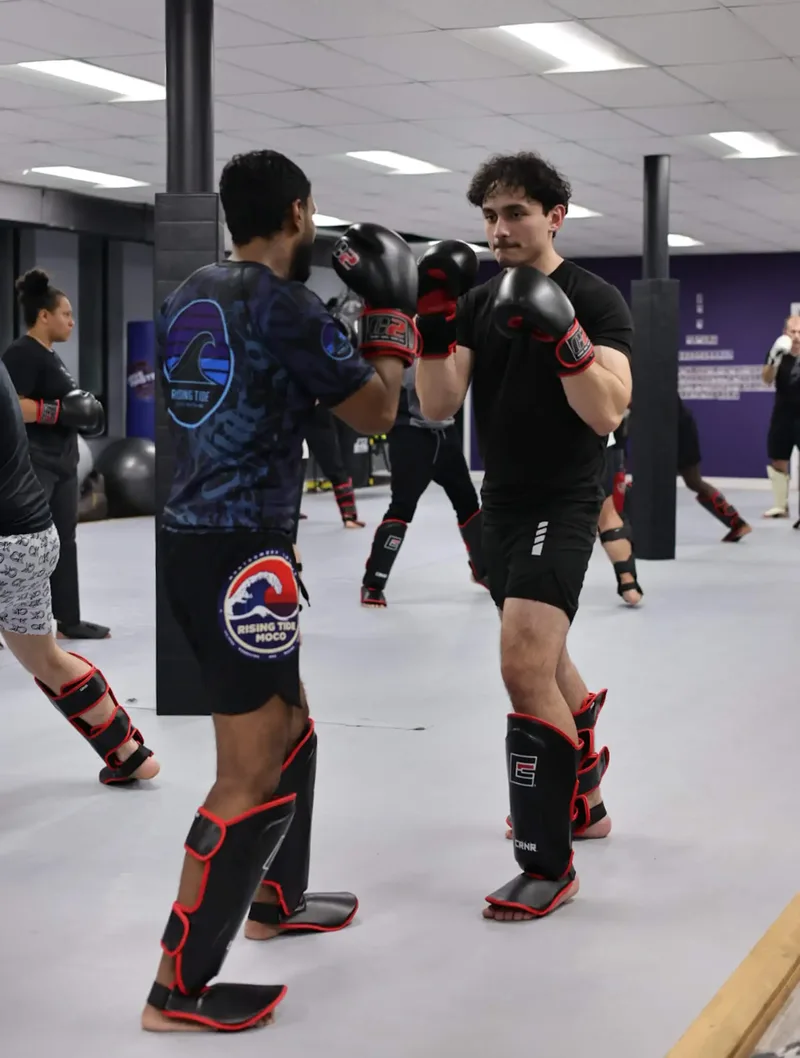
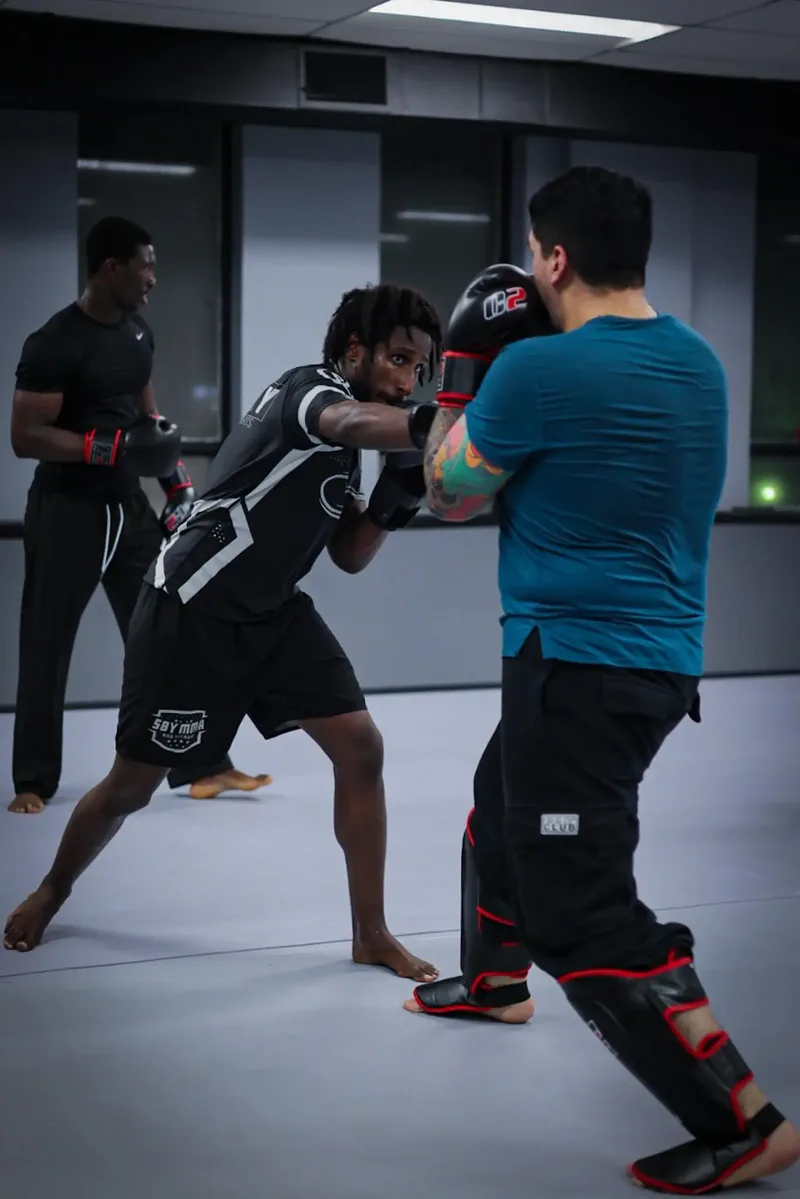
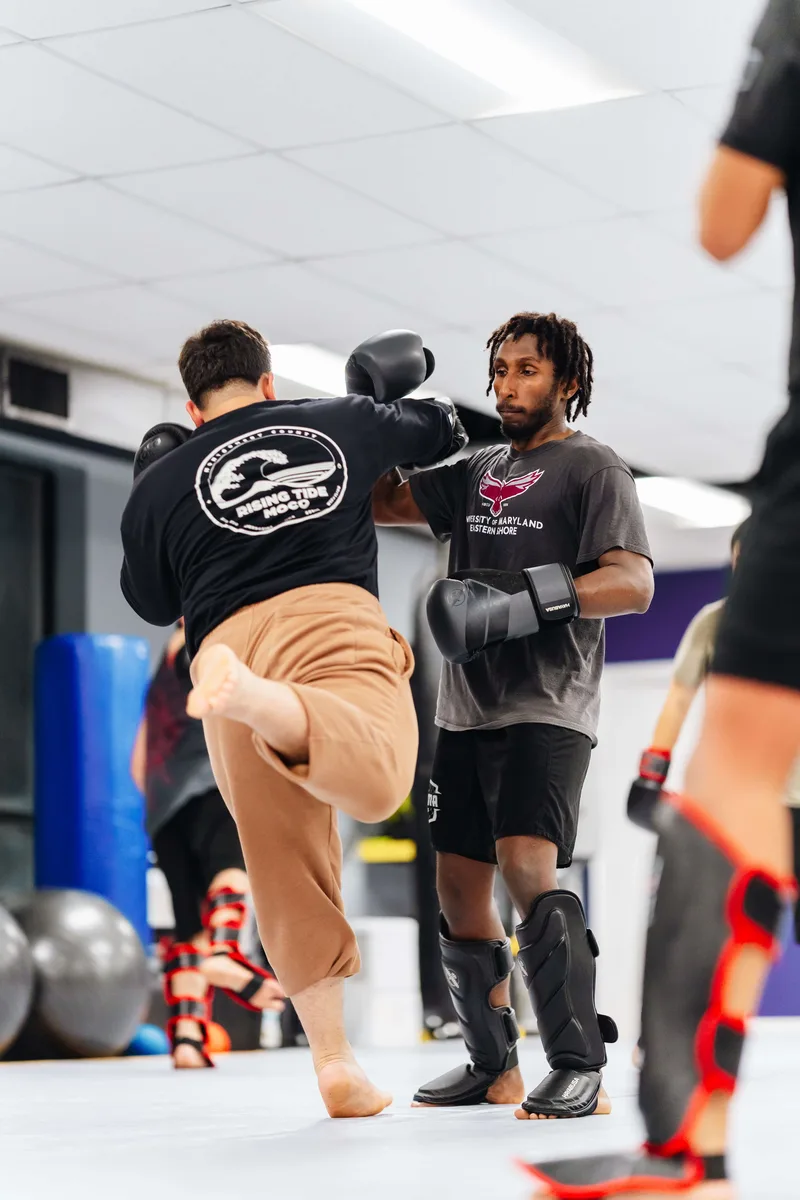
Our boxing and kickboxing program is a deliberate blend. The kickboxing curriculum draws from both Muay Thai and Dutch kickboxing: Dutch-style punch-kick combinations, Muay Thai roundhouse kicks, push kicks, knees, and elbows, plus clinch fighting and close-range striking. You get the hands of a kickboxer and the clinch of a Thai boxer, without having to pick one tradition.
Adult Kickboxing runs Monday and Wednesday at 9:00 AM, Tuesday and Thursday at 7:30 PM, and Saturday at 10:00 AM. Adult Boxing runs five days a week if you want to sharpen your hands separately. Friday at 7:30 PM is Boxing/Kickboxing Sparring for members who've built the foundation and want to test it — always optional, always supervised.
If your interest is the cage, our Adult MMA program takes the same striking and adds takedown defense, cage work, and grappling.
We're at 5408 Randolph Road in Rockville, second floor, with free parking out front. Members drive in from across Montgomery County — see kickboxing near Wheaton, kickboxing near Glen Echo, or the North Bethesda martial arts page for directions and drive times.
Your first class is free. Nobody spars on day one.
The Bottom Line
Muay Thai is the art of eight limbs: elbows, knees, the clinch, and a patient, powerful style built around balance and effect. Kickboxing — especially the Dutch-influenced style that dominates modern competition — trades the elbows and most of the clinch for fast punching combinations that finish with a kick.
For fitness, either one works. For self-defense and MMA, Muay Thai's clinch gives it a real edge. For your first year, the fundamentals are nearly identical, and the quality of the coaching matters far more than the name on the door.
The best answer, if you can find it, is a gym that teaches both.
Frequently Asked Questions
Is Muay Thai harder than kickboxing?
Muay Thai has more to learn, because the clinch, elbows, and kick-catching add whole skill sets that most kickboxing rule sets leave out. Kickboxing often feels faster-paced minute to minute. Neither is "harder" for a beginner; both start with the same fundamentals and scale to whatever intensity you choose.
Is Muay Thai or kickboxing better for beginners?
Both work well for beginners, and the first several months look nearly identical: stance, jab, cross, roundhouse kick, guard, and footwork. The coaching quality and class structure matter more than the style. Look for a gym where coaches correct your technique individually and sparring is optional.
Is Muay Thai better than kickboxing for self-defense?
Usually, yes, because of the clinch. Real confrontations often involve grabbing and close-range tie-ups, and Muay Thai trains you to control someone at that range and strike your way out. Neither art covers the ground, though, which is why many people add Jiu-Jitsu or wrestling.
Which is better for MMA, Muay Thai or kickboxing?
MMA striking borrows from both. Muay Thai's clinch, knees, and elbows translate directly to cage fighting, while Dutch-style combinations and low kicks are just as common. In practice, MMA fighters blend the two and adapt everything to the constant threat of takedowns.
Do Muay Thai and kickboxing use the same gear?
Mostly. Both use boxing-style gloves, hand wraps, shin guards for sparring, and a mouthguard. Muay Thai gloves are often slightly more flexible to allow clinch grips, but most beginners can use standard training gloves for either. Many gyms provide loaner gloves for your first class.