The Short Answer
BJJ helps with stress and anxiety in a way few other activities do, because it combines four things at once: hard physical exercise, total present-moment focus, practice staying calm under controlled pressure, and a community of people who expect to see you.
The evidence that vigorous exercise reduces anxiety and stress is strong. Research on Brazilian Jiu-Jitsu specifically is newer and smaller, but early studies are promising. And the experience many practitioners describe — walking out of class feeling like their brain has been reset — has clear explanations.
One important note before we go further: BJJ is a powerful complement to mental health care, not a replacement for it. If anxiety is significantly affecting your life, talk to a doctor or mental health professional. Then, if you want, come train.
What the Research Says
Exercise and anxiety
The broadest evidence comes from research on exercise in general. A large 2023 umbrella review in the British Journal of Sports Medicine (Singh et al.) pulled together 97 systematic reviews covering more than 1,000 trials and over 128,000 participants. Physical activity produced medium-sized improvements in symptoms of depression, anxiety, and psychological distress compared with usual care, and higher-intensity activity was associated with greater improvements.
The authors noted that many of the underlying reviews were of limited methodological quality, so the exact size of the effect is debatable. But the direction is consistent: moving your body hard and regularly helps your mind. A Jiu-Jitsu class is, among other things, an hour of high-intensity interval training — we covered the physical side in BJJ for fitness.
BJJ specifically
A 2019 study in Military Medicine (Willing et al.) followed U.S. service members and veterans with symptoms of PTSD through a program of 40 Jiu-Jitsu sessions over five months. Participants reported improvements in PTSD symptoms, along with reduced symptoms of depression and generalized anxiety, and reduced alcohol use.
That study had no control group, so it can't prove BJJ caused the improvements. Researchers have since registered a randomized trial comparing Jiu-Jitsu with yoga for veterans' PTSD symptoms, which should give a clearer answer. For now, the honest summary is: the BJJ-specific evidence is early but encouraging, and it fits well with what we know about exercise.
Five Ways BJJ Works on Your Mind
1. It forces you into the present
Anxiety lives in the future and stress lives in the inbox. Jiu-Jitsu doesn't let you visit either.
When someone is trying to pass your guard or settle into side control, every bit of attention you have goes into the next few seconds: their hips, their grips, your frames. You can't replay a conversation from work or rehearse tomorrow's worries, because the moment you drift, you get swept.
Psychologists describe a state called flow — complete absorption in a challenging task that matches your skill level. Live Jiu-Jitsu rounds produce it reliably. For people whose minds rarely go quiet, that hour of enforced presence can be the most restful part of the day, even though it's physically exhausting.
2. It trains calm under controlled pressure
Being pinned under a heavier training partner is genuinely uncomfortable. The first few times, most people panic: they hold their breath, push wildly, and burn out in seconds.
Over weeks, something changes. You learn that discomfort is survivable, that panicking makes it worse, and that breathing slowly and thinking clearly gets you out. You're practicing staying composed in a stressful situation, deliberately, a few times a week, with an exit always available — you can tap at any moment and the round stops.
That loop — uncomfortable situation, calm response, safe resolution — echoes the logic of gradual exposure. Many practitioners say the composure they built on the mat started showing up in hard conversations, presentations, and bad days.
3. It retrains your breathing
Anxiety and shallow, rapid breathing feed each other. Jiu-Jitsu teaches you, through necessity, to breathe slowly under load. You can't last a five-minute round otherwise.
Over time, slow breathing becomes your default under pressure on the mat, and often off it. If you want to accelerate that, yoga pairs well with grappling; we explained why in yoga for martial artists.
4. It wears you out — in a good way
Hard training brings a deep physical tiredness that many people find calming. It's the kind of exhaustion that makes it easier to wind down at night, and regular exercise is widely associated with better sleep, which in turn affects stress and mood.
5. It gives you people
Adult life can be isolating, and loneliness amplifies stress. A Jiu-Jitsu gym is a community in a very literal sense: you see the same people several times a week, you work together to get better, and they notice when you're missing.
There's also something about rolling with someone — the laughing, the shared struggle, the handshake afterward — that builds connection faster than almost anything else. Plenty of people come for the workout and stay for the people.
When BJJ Can Make Anxiety Worse
Being honest about this matters, because the wrong start can turn a helpful activity into a stressful one.
The wrong gym. A room full of ego-driven, competition-only training can feel threatening rather than calming. Look for a gym where beginners are protected and coaches set the tone.
Feeling trapped. For some people, being held down can trigger panic, particularly early on. This usually eases with gradual exposure, but go slowly, tap early, and tell your coach in advance.
Too much, too soon. Overtraining and injuries are stressors in their own right. Two or three classes a week is plenty to start.
Treating it as therapy instead of training. BJJ can make you feel better, but it isn't designed to treat a mental health condition. If symptoms are severe or getting worse, professional support comes first.
How to Start If You're Anxious About Starting
If the idea of walking into a Jiu-Jitsu class makes you nervous, you're in good company. Some practical steps:
- Call or text first. Ask your questions before you arrive. Hearing a coach's voice makes the first visit much less abstract.
- Arrive early. About 15 minutes gives you time to meet the coach, see the room, and change without rushing.
- Tell your coach what's going on. You don't have to share details. "I get anxious, and I'd like to ease in" is enough.
- Drill first, roll later. At a good gym, live rolling starts only when you're ready.
- Know you can step off. Taking a break is always allowed.
- Consider a women's-only class if that would feel more comfortable.
Not sure what to wear or bring? What to wear to your first martial arts class covers it.
BJJ for Stress Relief at Rising Tide
Our Jiu-Jitsu and wrestling program is built for adults with full lives. Adult Jiu-Jitsu runs at 6:30 AM Monday, Wednesday, and Thursday, at noon Monday through Friday, in the evening Monday through Friday, and Saturday at 11:00 AM. That means you can train before work, reset at lunch, or burn off the day before going home.
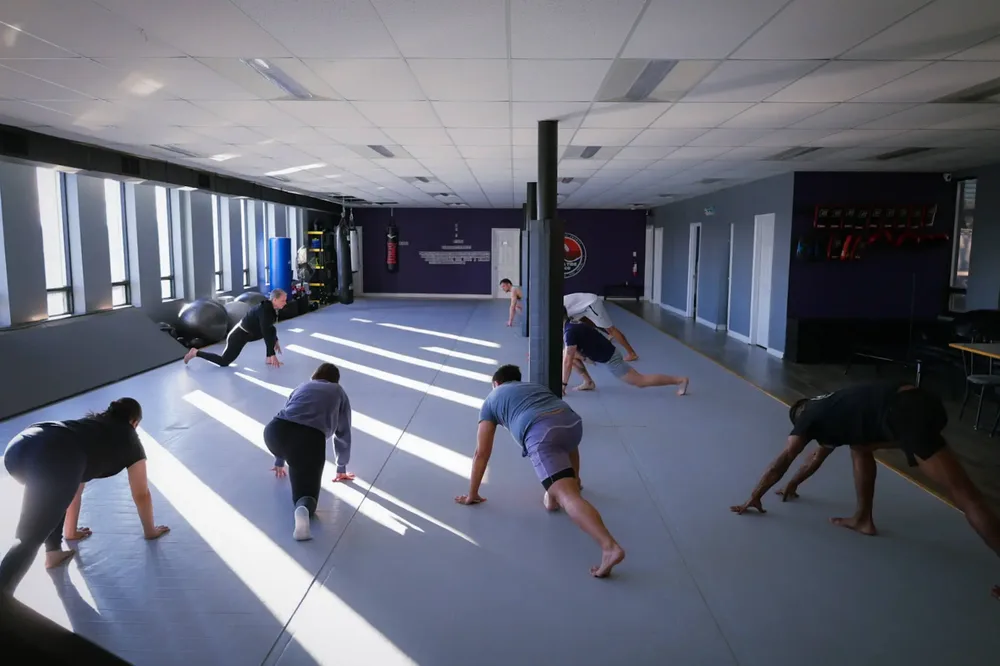
New students drill with patient partners, learn at their own pace, and add live rolling only when they're ready. Our Women's Only Jiu-Jitsu classes run Tuesday (no-gi) and Thursday (gi) at 6:30 PM. And Sunday yoga at 9:00 AM is a natural pairing for anyone who wants to work on breathing and recovery.
If you're starting later in life, starting martial arts at 30, 40, or 50 covers how to begin sensibly.
We're at 5408 Randolph Road in Rockville, second floor, with free parking, locker rooms, and a shower on site. Members come from across the county — see Jiu-Jitsu near Kensington, Jiu-Jitsu near Potomac, or women's Jiu-Jitsu near North Bethesda for directions and drive times.
Your first class is free. Call or text first if that helps.
The Bottom Line
BJJ helps with stress and anxiety by combining vigorous exercise, total focus on the present, practice staying calm under pressure, better breathing, and a real community. The research on exercise is strong, and early research on Jiu-Jitsu itself is promising.
It isn't a replacement for professional care, and the wrong gym or too fast a start can backfire. But with a patient coach, a gradual start, and two or three classes a week, many people find that the hour on the mat becomes the calmest part of their week — even though it's the hardest.
Frequently Asked Questions
Does BJJ help with anxiety?
For many people, yes. Brazilian Jiu-Jitsu combines vigorous exercise, which research consistently links to reduced anxiety, with total present-moment focus and practice staying calm under pressure. Studies specific to BJJ are early but encouraging. It works best as a complement to, not a replacement for, professional care.
Is BJJ good for stress relief?
Yes. A Jiu-Jitsu class demands complete focus, which crowds out rumination, and its high-intensity rounds provide the kind of physical exertion linked to lower stress. Many practitioners describe leaving class feeling mentally reset, and the community aspect adds social support.
Can BJJ make anxiety worse?
It can, if you start too fast or at the wrong gym. Being held down can trigger panic for some people early on, and ego-driven training rooms feel threatening. Start with drilling, tap early, tell your coach you'd like to ease in, and choose a gym where beginners are protected.
Is BJJ good for PTSD?
Early research is promising. A 2019 study of service members and veterans with PTSD symptoms found improvements in PTSD, depression, and anxiety symptoms over five months of training, though it had no control group. BJJ should complement, not replace, professional treatment for PTSD.
How often should I train BJJ for mental health?
Two to three classes a week is a good target for most adults. That's enough for consistent benefits from exercise and community, while leaving time to recover. Training more often is fine once your body adapts, but consistency matters more than volume.