The Short Answer
Yes — BJJ for fitness is one of the most complete workouts you can do. A single Jiu-Jitsu class trains strength endurance, cardiovascular conditioning, grip, core, and mobility at the same time, against a partner who is actively resisting.
But the biggest fitness advantage of Brazilian Jiu-Jitsu isn't on that list. It's that people actually keep doing it. BJJ is a problem-solving game, and when your attention is on escaping a pin or finishing a sweep, you stop noticing that you're working harder than you would in almost any gym class. The best workout is the one you're still doing a year from now, and that's where Jiu-Jitsu quietly wins.
Here's what it builds, what it burns, and where it falls short.
What a BJJ Class Actually Does to Your Body
Most Jiu-Jitsu classes follow a similar arc, and each phase trains something different.
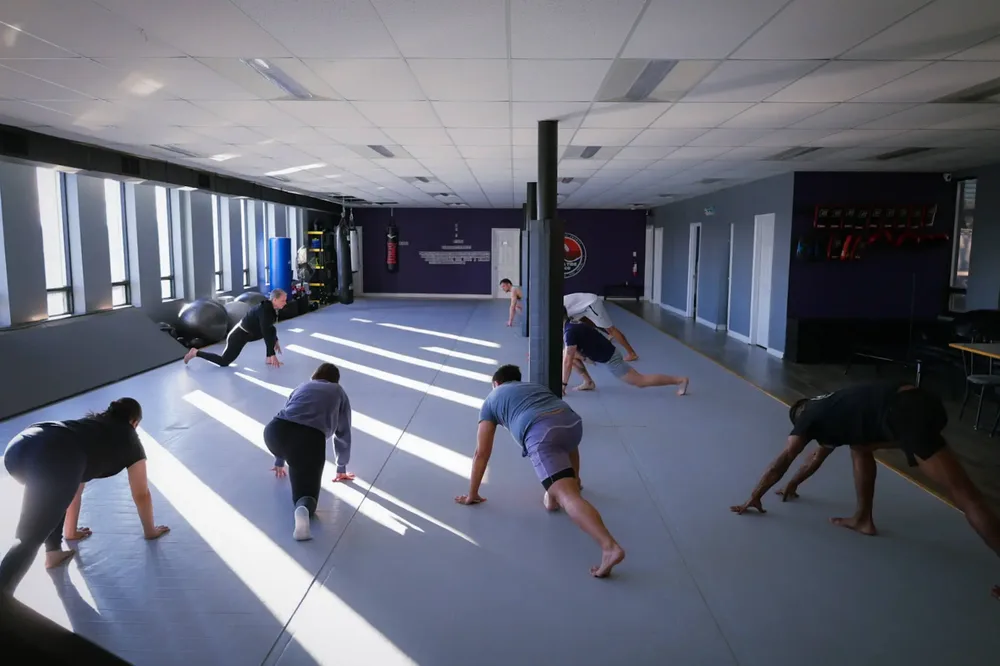
The warm-up is usually movement drills unique to grappling: shrimping (hip escapes) down the mat, bridging, technical stand-ups, forward and backward rolls. It's a mobility and core session disguised as a warm-up — and it's the part that humbles most fit newcomers.
Technique is lower intensity: you learn a move and drill it with a partner, rep after rep. Your heart rate comes down, but you're still lifting, turning, and controlling another human body.
Positional sparring starts from a specific position — one person in mount, one trying to escape — and goes live for a minute or two. Intensity climbs sharply.
Live rolling is the full-intensity part: rounds of five or six minutes of resisting, scrambling, and problem-solving, with short breaks between. Studies that put heart-rate monitors on grapplers during sparring typically find heart rates in the range you'd expect from hard interval training.
That arc — moderate, low, high, very high — is interval training by another name.
BJJ for Fitness: What It Builds
Strength endurance
Jiu-Jitsu rarely asks for one maximal effort. It asks you to push, pull, hold, and frame against a partner's bodyweight for minutes at a time. That builds the kind of strength that lasts: the ability to keep working when your muscles are already tired. Many people who switch from the weight room are surprised to find themselves exhausted by someone smaller who knows how to make them carry their own weight.
Conditioning
Rolling mixes short bursts — a scramble, a takedown attempt, a fast guard pass — with longer stretches of grinding effort. That combination trains both your aerobic base and your ability to recover between bursts. Beginners gas out in two minutes. After a few months, the same people roll for five rounds.
Grip and forearms
Especially in the gi, Jiu-Jitsu builds grip strength that few other activities touch. Holding sleeves and collars while someone tries to break your grips is a forearm workout no wrist curl can replicate. Expect your first few weeks to include forearms that feel like they belong to someone else.
Core
Almost every Jiu-Jitsu movement runs through the trunk: bridging, shrimping, sitting up, rotating, stabilizing while someone tries to knock you over. Your abs and obliques get trained in every direction, under load, without a single crunch.
Mobility
Guard work demands hip rotation and spinal mobility, and the movement drills train it every single class. Many people find they move better at 40 after a few years of Jiu-Jitsu than they did at 30. (If you want to accelerate that, yoga for martial artists covers the best pairing.)
How Many Calories Does BJJ Burn?
Like any activity, calorie burn scales with body weight and intensity. The Compendium of Physical Activities — the reference researchers use to estimate the energy cost of exercise — rates slower-paced martial arts practice at roughly 5 METs and moderate-pace martial arts at roughly 10. A real Jiu-Jitsu class blends both: technique at the low end, live rolling at the high end.
Here's a realistic range for a full 60-minute class, including warm-up, technique, rolling, and breaks:
| Body Weight | 30 Minutes | 60 Minutes |
|---|---|---|
| 130 lbs | 175 – 235 | 350 – 475 |
| 155 lbs | 210 – 280 | 420 – 560 |
| 185 lbs | 250 – 335 | 500 – 670 |
| 215 lbs | 290 – 390 | 585 – 780 |
The low end of each range is a technique-heavy class. The high end is a class with more live rounds. Open mats with continuous rolling can run higher.
That puts BJJ in the same neighborhood as kickboxing — we broke down those numbers in kickboxing calories burned — and well above steady-state cardio machines for most people. Treat any claim of "1,000 calories per class" with suspicion; it's not true for almost anyone.
Why BJJ Beats the Gym for Many People
Most people don't fail at fitness because they picked the wrong workout. They fail because they stop.
Jiu-Jitsu has a handful of features that make stopping less likely:
Your attention is elsewhere. On a treadmill, you're aware of every minute. In a roll, you're thinking about frames, angles, and your partner's next move. Perceived effort drops even when actual effort is high.
It's a game you can get better at. Every class, you learn something. Every few weeks, a technique that never worked suddenly works. That steady sense of progress is a powerful reason to come back.
People expect you. Training partners notice when you're missing. That light social accountability beats any app reminder.
There's always a next goal. A new technique, a stripe, a belt, a partner you finally keep up with. The goals are built in, and none of them are about the scale.
The result: people who have quit three gym memberships often find themselves still training Jiu-Jitsu years later — and much fitter for it.
Where BJJ Falls Short as a Fitness Program
Jiu-Jitsu is a great fitness foundation, but it isn't a complete program on its own. Honestly:
It won't maximize raw strength. You'll get stronger, especially at first, but building maximal strength requires progressive heavy lifting. Many grapplers add one or two short strength sessions a week.
It can reinforce rounded posture. Grappling spends a lot of time curled forward. Pulling movements, upper-back mobility, and hip-opening work balance it out.
Injuries happen. Most are minor — jammed fingers, mat burns, sore ribs — but contact sports carry more risk than a stationary bike. The biggest risk factor is ego: tapping early and choosing calm training partners prevents most of it.
You can't out-train your diet. If weight loss is the goal, Jiu-Jitsu supplies the activity and the motivation, but the scale still answers to what you eat.
None of these are reasons to skip BJJ. They're reasons to round it out sensibly.
Gi vs No-Gi for Fitness
Both are excellent workouts, with different flavors.
Gi training is slower and more methodical, with heavy emphasis on grips. It builds tremendous grip and forearm strength, and the pace is easier to manage for beginners.
No-gi is faster and more scramble-heavy, without grips to slow things down. It often feels more like conditioning work minute to minute.
Most people do both. We compared them in detail in gi vs no-gi Jiu-Jitsu.
What to Expect Physically in Your First Months
Weeks 1–2: Soreness in places you didn't know you had — neck, forearms, the sides of your abs, the muscles between your ribs. You'll be gassed fast, mostly because you're tense and holding your breath.
Months 1–3: The fastest improvement curve you'll ever experience. Your conditioning jumps, and more importantly, you learn to relax, which cuts how much energy each roll costs.
Months 3–6: Body composition starts changing for people who train consistently and eat reasonably. Daily life gets easier — carrying groceries, playing with kids, getting up off the floor.
Beyond: The workout never gets "easy," because your partners get better at the same rate you do. That's the point.
If you haven't taken your first class yet, what to expect at your first BJJ class covers the practical side.
BJJ for Fitness at Rising Tide
Our Jiu-Jitsu and wrestling program is built so fitness can fit your schedule, not the other way around. Adult Jiu-Jitsu runs at 6:30 AM Monday, Wednesday, and Thursday, at noon Monday through Friday, in the evening Monday through Friday (an Adult Gi class at 5:30 PM on Thursday, 6:30 PM the other nights), and Saturday at 11:00 AM. The Friday 7:30 PM open mat is there when you want extra rounds.
For women who'd rather start in a women-only room, our Women's Only Jiu-Jitsu classes run Tuesday (no-gi) and Thursday (gi) at 6:30 PM.
Every class is scaled for beginners. You'll drill with patient partners, learn at your own pace, and add live rolling only when you're ready — and once you do, you choose your intensity.
We're at 5408 Randolph Road in Rockville, second floor, with free parking, locker rooms, and a shower for anyone heading to work after a 6:30 AM class. Members train with us from all over the county — see Jiu-Jitsu near Cabin John, Jiu-Jitsu near Glen Echo, or women's Jiu-Jitsu near Bethesda for directions and drive times.
Your first class is free. Come find out what your gym routine was missing.
The Bottom Line
BJJ for fitness delivers strength endurance, conditioning, grip, core strength, and mobility in one session — and it burns roughly as many calories as kickboxing, depending on your size and how hard you roll.
It isn't a complete program by itself: add some strength work and mobility, and keep an eye on what you eat. But its real advantage has nothing to do with any of those numbers. Jiu-Jitsu is engaging enough that people keep doing it for years.
That's the workout that changes your body: the one you don't quit.
Frequently Asked Questions
Is BJJ a good workout?
Yes. A Jiu-Jitsu class combines interval-style conditioning, strength endurance, grip and core work, and mobility training, all against a resisting partner. Most people burn roughly 350 to 780 calories per hour depending on body weight and intensity, and the engaging nature of the sport helps people stay consistent.
Can you get in shape just doing BJJ?
You can get in very good shape training Jiu-Jitsu consistently, especially three or more times a week. For a well-rounded program, many people add one or two short strength sessions and some mobility work, and pay attention to nutrition if weight loss is the goal.
Is BJJ good for weight loss?
It can be. BJJ burns a substantial number of calories, builds muscle, and — most importantly — is something people stick with. Weight loss still depends on diet, but Jiu-Jitsu provides the consistent activity and motivation that make a lasting change much easier.
Do I need to be in shape before starting BJJ?
No. Classes are designed for beginners, and you control the intensity of your live rounds. Most people find their conditioning improves faster in the first three months of Jiu-Jitsu than at any other point, because they're learning to relax and breathe at the same time.
How many times a week should I train BJJ for fitness?
Two to three classes a week is a strong starting point for fitness and skill. Beginners should give their bodies time to adapt before training daily. Consistency over months matters far more than any single week of heavy training.