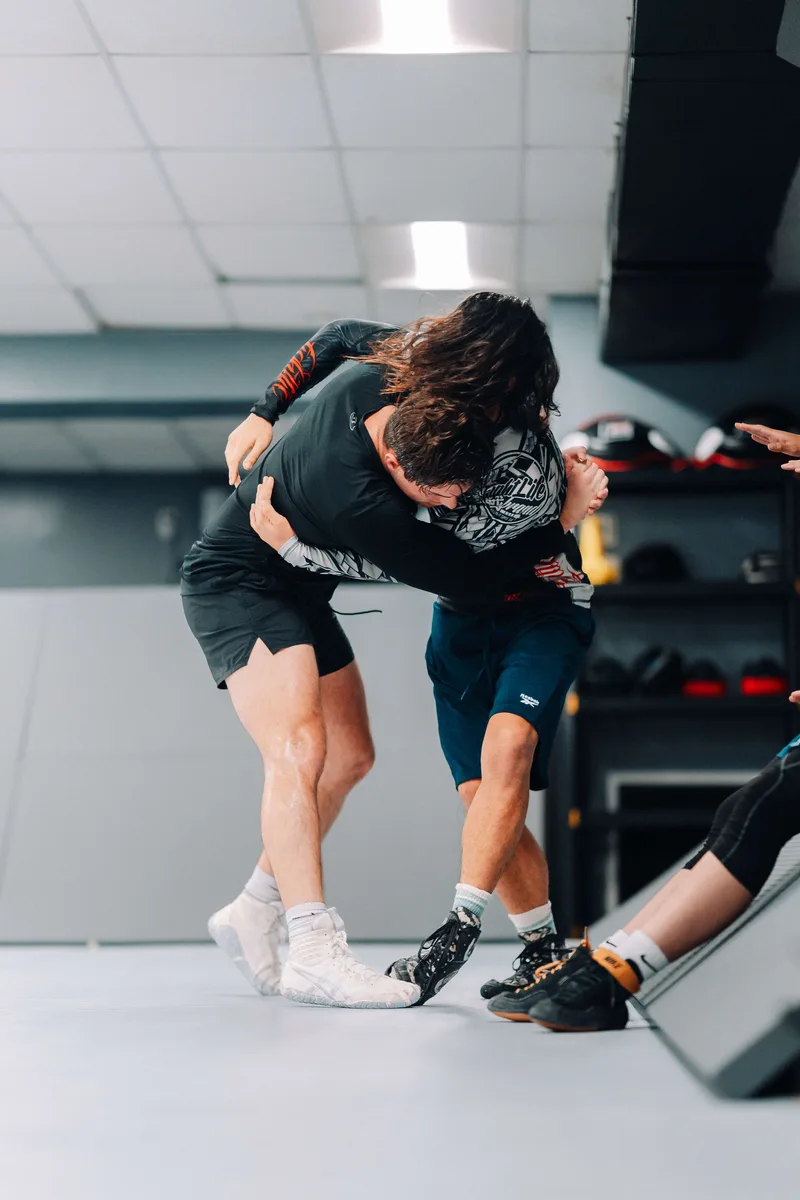
The Short Answer
The difference between boxing vs MMA is depth versus breadth. Boxing uses only punches, and it takes those punches — along with footwork, head movement, and timing — deeper than any other combat sport. MMA (mixed martial arts) combines striking, wrestling, and Jiu-Jitsu into the most complete fighting system there is.
Choose boxing if you want to master one thing, build the best hands possible, or get a demanding, straightforward workout. Choose MMA if you want the most complete self-defense skill set, more variety, or the full sport.
And if you can't decide, you don't have to: most serious MMA fighters train boxing anyway, and the two complement each other better than almost any other pairing.
Boxing vs MMA at a Glance
| Boxing | MMA | |
|---|---|---|
| Weapons | Punches only | Punches, kicks, knees, elbows, takedowns, submissions |
| Stance | Bladed and upright | Wider and lower, ready to stop takedowns |
| Defense | Head movement, footwork, blocking | All of that, plus sprawling and checking kicks |
| Gloves | 14–16 oz in training | Small 4 oz gloves in competition |
| Pro rounds | Typically 3 minutes | 5 minutes |
| Range | Punching range | Every range, standing and on the ground |
| Learning curve | One deep skill | Many skills at once |
What Boxing Does Better
Hands. No other discipline develops punching technique, combinations, and hand speed like boxing. Boxers learn to throw from every angle, to put punches together in rhythm, and to land them while moving. Many MMA fighters with the most dangerous hands came up through boxing gyms.
Head movement and defense. Slipping, rolling, and parrying punches is boxing's specialty. A boxer learns to make people miss by inches and punish them for it.
Footwork and distance. Boxing footwork — cutting angles, controlling the ring, stepping in and out of range — is an art form of its own.
Simplicity. With one set of tools, beginners make visible progress quickly. You're not splitting your attention between punching, kicking, takedowns, and the ground. For many people, that focus is exactly what makes training satisfying.
Conditioning. Boxing workouts are brutally efficient: bag rounds, pad rounds, footwork drills, and conditioning circuits. It's some of the best cardio in any sport. If you want to know what day one feels like, what to expect at your first boxing class walks through it.
What MMA Does Better
Completeness. MMA covers every phase a real confrontation can move through: striking range, the clinch, takedowns, and the ground. Boxing covers one.
Self-defense. Real altercations close distance fast, and many end up tied up or on the ground. A boxer has superb tools at punching range and almost nothing once someone grabs them. MMA trains the transitions — stopping a takedown, getting up, controlling someone on the ground.
Variety. Some people love going deep on one thing. Others get bored. MMA's mix of striking and grappling keeps training fresh for years.
Transferable foundations. The wrestling and Jiu-Jitsu you learn in MMA stand on their own as full martial arts. We explained why wrestling matters so much in wrestling for MMA.
How Boxing Changes Inside MMA
Boxing is a huge asset in MMA, but it doesn't transfer one-to-one. The rules change the game.
The stance widens. A classic boxing stance — bladed, weight forward, lead leg heavy — is vulnerable to leg kicks and takedowns. MMA fighters stand a bit wider and more square.
Head movement gets more careful. Ducking low to slip punches works beautifully in boxing. In MMA, ducking low puts your head in range of knees and makes level changes easier to read.
Small gloves change defense. Big boxing gloves let you hide behind a tight guard. Four-ounce MMA gloves don't cover nearly as much, so fighters rely more on distance and movement than on blocking.
The threat of the takedown is everywhere. Every punch you throw in MMA has to account for the possibility that your opponent will change levels and shoot. That's why striking for MMA often borrows from Muay Thai and kickboxing as well — something we covered in Muay Thai vs kickboxing.
None of this makes boxing less useful. It means boxing for MMA is adapted boxing.
Which Is Better for Fitness?
Both are outstanding. Boxing is more consistently cardio-heavy: bag and pad rounds keep your heart rate high for most of the class. MMA adds more strength-endurance work through wrestling and grappling, and it trains your body in more directions.
If your main goal is getting in shape, choose the one you'll enjoy enough to keep doing. Consistency outranks the choice of discipline every time.
Which Is Better for Self-Defense?
MMA, clearly. Boxing gives you excellent striking, distance awareness, and the ability to stay composed when things come at your face — all valuable. But it leaves you with nothing in the clinch or on the ground, which is where many real altercations end up.
That said, any striking art is only half the picture. We broke down exactly where striking helps and where it runs out in is kickboxing good for self-defense; the same logic applies to boxing.
What About Safety?
The honest answer: in both sports, the main long-term risk is repeated head contact from hard sparring. That's true whether the contact comes from boxing gloves or MMA gloves.
For recreational trainees, the risk is manageable and largely in your control. Choose a gym where sparring is controlled, supervised, and optional, where beginners don't spar until they have the fundamentals, and where coaches stop rounds that get out of hand. You can train either sport for years, get in excellent shape, and never take a hard shot.
Boxing vs MMA: Which Should You Start With?
If you want to compete in boxing: Boxing. Specialize early.
If you want to compete in MMA: Start MMA fundamentals, or start with either boxing or grappling and add the other quickly. Don't wait years to add wrestling and Jiu-Jitsu.
If you want self-defense: MMA, or a combination of a striking art and a grappling art.
If you want fitness and fun: Whichever class you leave smiling from. Try both.
If you honestly don't know: Try both. At our academy, one membership covers every adult program, so you don't have to choose before you start.
How We Train Both at Rising Tide
Our boxing and kickboxing program runs Adult Boxing five days a week: Monday and Wednesday at 7:30 PM, and Tuesday, Thursday, and Friday at 9:00 AM. Classes cover stance and footwork, combinations, head movement, counter-punching, and pad and bag work. If you're curious how boxing compares to kickboxing, boxing vs. kickboxing covers that choice.
Our Adult MMA program runs MMA on Monday at 7:30 PM and Thursday at 6:30 PM, with MMA Striking on Friday at 5:30 PM. It blends boxing footwork with kickboxing range, clinch work, and takedown defense, then ties it to the grappling side. Friday at 7:30 PM, Boxing/Kickboxing Sparring is available for members with a solid foundation — always optional and supervised.
If you want to sample everything before deciding, our adult martial arts program explains how one membership covers boxing, kickboxing, MMA, Jiu-Jitsu, and wrestling.
We're at 5408 Randolph Road in Rockville, second floor, with free parking out front. Adults train with us from across the county — see boxing near Silver Spring, boxing near Gaithersburg, or adult martial arts near Aspen Hill for directions and drive times.
Your first class is free, and nobody spars on day one.
The Bottom Line
Boxing vs MMA is a choice between going deep and going wide. Boxing builds the best hands, head movement, and footwork in combat sports, with a simple, focused path to improvement. MMA builds a complete skill set that covers every range a fight can reach.
For competition, pick the sport you want to compete in. For self-defense, MMA wins. For fitness, pick the one you'll keep doing.
And remember that it isn't really a rivalry. The best MMA fighters train boxing, and the best boxers who cross over learn to wrestle. If you can, train both.
Frequently Asked Questions
Is boxing or MMA better for beginners?
Both are beginner-friendly at a good gym. Boxing is simpler, with one set of tools, so beginners often see progress faster. MMA has more to learn but more variety. Choose based on your goals: boxing for focused striking and fitness, MMA for a complete skill set and self-defense.
Is MMA harder than boxing?
MMA has more to learn because it combines striking, wrestling, and Jiu-Jitsu. Boxing is narrower but extremely deep, and mastering it takes years. For a beginner, neither is "harder" — both scale to your fitness and experience, and good gyms let you set your own intensity.
Should I learn boxing before MMA?
You don't have to. Boxing is an excellent foundation for MMA striking, but you'll need to adapt your stance and defense for kicks and takedowns. Many people start MMA fundamentals directly, or train boxing and grappling side by side from the beginning.
Is boxing or MMA better for self-defense?
MMA is better for self-defense because it covers the clinch and the ground, where many real confrontations end up. Boxing is excellent at punching range and builds composure under pressure, but leaves you without tools if someone grabs you or takes you down.
Can I train boxing and MMA at the same time?
Yes, and they complement each other well. Boxing sharpens your hands and head movement while MMA adds kicks, wrestling, and ground skills. Two to four classes a week split between them is a strong schedule for most adults.